Livestock Heat Stress: Signs, Emergency Response & Summer Management for US Farms
By FarmVetGuide Editorial Team · Published April 2026 · Updated March 2026 · Based on verified data from our directory of 9,500+ practices
Every summer, American livestock producers face a silent, costly threat that doesn't announce itself with dramatic fanfare — it builds quietly across days of climbing temperatures and stifling humidity until animals that were thriving last week begin to struggle. Heat stress in livestock is one of the leading causes of reduced performance, fertility loss, and preventable death on US farms, costing the beef, dairy, swine, and poultry industries an estimated $1.7 to $2.4 billion annually. Yet most of that damage is avoidable with the right knowledge, a proactive management plan, and fast action when animals start to show early warning signs.
This guide is written for working farmers and ranchers across the Sun Belt, the Corn Belt, and every region in between where summer temperatures regularly push livestock toward dangerous thresholds. You will find species-specific warning signs, the Temperature Humidity Index tables you need to make real-time management decisions, emergency response protocols, and a comprehensive summer management toolkit that you can implement before the heat arrives.
Understanding Heat Stress: The Science Behind the Suffering
Livestock are homeothermic animals — they work constantly to maintain a stable core body temperature within a narrow range. Cattle, for example, maintain a core temperature between 101.5°F and 102.5°F. When environmental heat load exceeds the animal's ability to dissipate heat through sweating, respiration, conduction, and radiation, core body temperature begins to rise. This is heat stress.
The critical insight most producers miss is that humidity matters as much as temperature. When relative humidity is high, evaporative cooling — the most efficient heat dissipation mechanism available to mammals — becomes dramatically less effective. A day that is "only" 85°F at 90% humidity can be more dangerous to your cattle than a 95°F day at 20% humidity.
The Temperature Humidity Index (THI)
The Temperature Humidity Index (THI) was developed specifically to quantify the combined heat and humidity burden on livestock. It is now the industry standard for making management decisions. The formula for THI is:
THI = (1.8 × Tc + 32) – [(0.55 – 0.0055 × RH) × (1.8 × Tc – 26)]
Where Tc is temperature in Celsius and RH is relative humidity as a percentage. Most producers use lookup tables rather than calculating manually.
THI Reference Table for Dairy and Beef Cattle
| Temperature (°F) | RH 20% | RH 40% | RH 60% | RH 80% | RH 90% |
|---|---|---|---|---|---|
| 75°F | 66 | 68 | 71 | 73 | 74 |
| 80°F | 70 | 73 | 76 | 78 | 80 |
| 85°F | 75 | 78 | 81 | 84 | 85 |
| 90°F | 79 | 83 | 86 | 90 | 91 |
| 95°F | 84 | 88 | 92 | 96 | 98 |
| 100°F | 88 | 93 | 97 | 102 | 104 |
| 105°F | 93 | 98 | 103 | 108 | 110 |
THI Alert Thresholds by Species
| Species | Alert (Mild Stress) | Danger (Moderate Stress) | Emergency (Severe Stress) |
|---|---|---|---|
| Dairy Cattle (high-producing) | THI ≥ 68 | THI ≥ 72 | THI ≥ 80 |
| Beef Cattle | THI ≥ 72 | THI ≥ 79 | THI ≥ 84 |
| Horses | THI ≥ 150* (sum method) | THI ≥ 170* | THI ≥ 180* |
| Swine | THI ≥ 74 | THI ≥ 78 | THI ≥ 84 |
| Sheep & Goats | THI ≥ 22** (BGTHI) | THI ≥ 25** | THI ≥ 28** |
| Poultry (broilers) | Temp ≥ 80°F | Temp ≥ 90°F | Temp ≥ 100°F |
* Horse THI uses Temperature + Dewpoint (°F) sum method. ** Small ruminants use Body Globe Temperature Humidity Index (BGTHI).
Understanding these thresholds is the foundation of every management decision you will make during summer heat events. Post this table in your barn office and check your local THI daily during May through September.
Recognizing Heat Stress: Species by Species
Cattle: Beef and Dairy
Cattle begin showing behavioral signs of heat stress before their core temperature rises to dangerous levels. Knowing these early signs is what separates producers who lose animals from those who manage through summer without incident.
Early warning signs (THI 68–72 for dairy, 72–79 for beef):
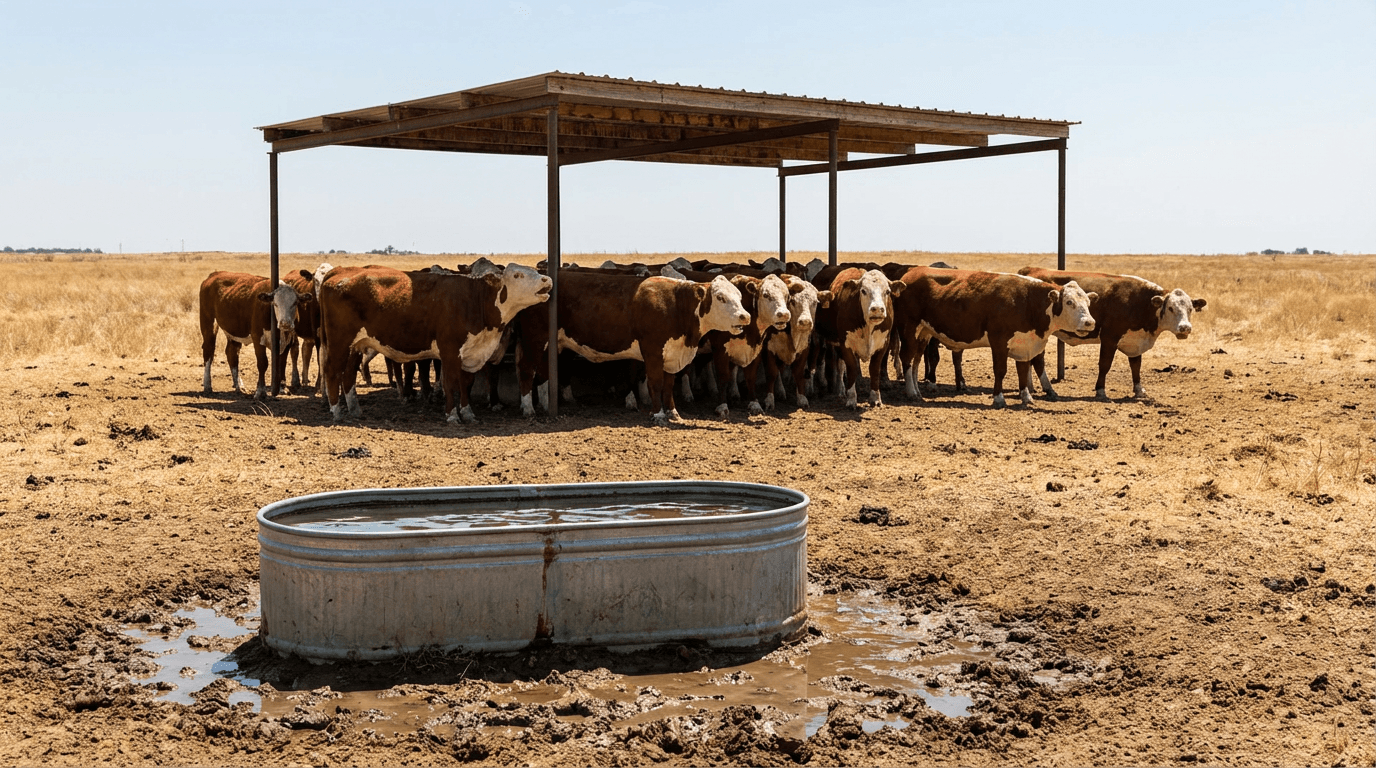
- Bunching in shaded areas or near water sources; hesitance to graze during daylight hours
- Increased water intake — cattle may drink 2–3 times their normal volume
- Reduced feed intake, especially during the warmest part of the day (10 AM–4 PM)
- Restlessness and frequent posture shifting
- Mild increase in respiratory rate (above 40 breaths per minute)
- In dairy herds, a measurable drop in milk production — often the first quantifiable signal
Moderate heat stress signs (THI 72–80 for dairy, 79–84 for beef):
- Open-mouth breathing, tongue partially extended
- Respiratory rate above 60–70 breaths per minute
- Profuse sweating and wet coat even in shade
- Significant drooling and frothing at the mouth
- Animals standing motionless with head down; reluctance to move
- Obvious crowding at water troughs with aggressive competition
- In feedlot cattle: bunching at the fence, especially on the north and east sides
Severe heat stress / emergency signs (THI above 84):
- Labored, open-mouth breathing with visible flank movement (panting)
- Rectal temperature above 104°F (normal 101.5–102.5°F)
- Staggering, weakness, or inability to stand
- Loss of coordination, muscle tremors
- Coma or collapse — requires immediate veterinary intervention
A critical rule for cattle producers: do not cool severely heat-stressed cattle with cold water sprayed directly on the head. This can trigger cerebral vasoconstriction and worsen outcomes. Cool the body (shoulders, back, sides) with large volumes of water and maximize airflow.
Horses
Horses are efficient sweaters but face a unique complication: their sweat is hypertonic, meaning it contains high concentrations of electrolytes (particularly sodium, chloride, potassium, and calcium). During prolonged heat exposure or exercise in hot, humid conditions, horses can rapidly become electrolyte-depleted, which compounds heat stress with metabolic disruption.
Heat stress signs in horses:
- Rectal temperature above 103°F (normal 99–101°F) — above 104°F is an emergency
- Skin remains tented when pinched (dehydration test) — normal skin springs back in under 2 seconds
- Heart rate above 60 bpm at rest (normal 28–44 bpm)
- Respiratory rate above 20 breaths per minute at rest
- Profuse sweating or, conversely, the cessation of sweating (anhidrosis) — both are dangerous
- Gums dry, tacky, or brick red; capillary refill time above 2 seconds
- Muscle cramping, reluctance to move, stiff gait
- In severe cases: synchronous diaphragmatic flutter ("thumps"), which indicates severe electrolyte imbalance and requires immediate veterinary care
The horse THI sum method: add the temperature (°F) and the dewpoint (°F). A sum above 150 warrants caution; above 170 indicates heat stress risk for horses in work; above 180 is dangerous even for horses at rest.
Swine
Pigs are physiologically the most heat-sensitive common livestock species. They have very few functional sweat glands and rely almost entirely on respiratory panting and wallowing for evaporative cooling. A pig cannot sweat its way through a heat wave — it must have access to cool water, shade, or mud.
Thermoneutral zones by pig class:
| Pig Class | Lower Critical Temp | Upper Critical Temp |
|---|---|---|
| Newborn piglets | 85–95°F | 100°F |
| Nursery pigs (15–50 lb) | 70–75°F | 85°F |
| Grow-finish pigs (50–250 lb) | 60–65°F | 75–80°F |
| Breeding sows | 60–65°F | 75°F |
| Boars | 60–65°F | 70°F |
Heat stress signs in swine:
- Panting, open-mouth breathing, rapid flank movement
- Lying spread out on cool concrete or in wet mud; reluctance to rise
- Reduced feed intake (voluntary feed intake can drop 10–15% for each degree above the upper critical temperature)
- In sows: reduced conception rates, increased embryo mortality in early pregnancy, increased stillbirths
- In boars: temporary infertility lasting 6–8 weeks after a heat stress event (due to damage to developing sperm cells)
- Severe cases: seizures, coma, death — particularly in farrowing houses
Sheep and Goats
Small ruminants tolerate heat better than cattle due to their smaller body mass and, in the case of goats, a more efficient panting response. However, heavily wooled sheep breeds face significant challenges, and all small ruminants in the southeastern US face dangerous conditions during July and August heat waves.
Heat stress signs in sheep and goats:
- Shade-seeking, bunching, and reduced grazing — particularly during 10 AM–4 PM
- Rapid, shallow breathing (tachypnea) above 40 breaths per minute
- Rectal temperature above 104°F (normal 101.5–104°F in goats; 102–104°F in sheep)
- In late-gestation ewes and does: increased risk of abortion and pregnancy toxemia under heat stress
- Reduced milk production in dairy breeds
- Heavily wooled ewes may show signs at lower temperatures than shorn sheep — summer shearing timing matters enormously
Emergency Response Protocol: When Animals Are in Crisis
When you find an animal in severe heat distress — collapsed, unresponsive, or showing severe neurological signs — the next 20–30 minutes are critical. Here is a step-by-step emergency protocol.
Immediate Actions (First 5 Minutes)
- Call your large animal veterinarian immediately. Do not wait to see if the animal improves on its own. Have your vet's number saved — use FarmVetGuide to find emergency large animal vets in your county if you don't already have one on call.
- Move the animal to shade. If the animal cannot walk, bring shade to it — park a trailer or tractor to create shadow while you work.
- Begin cooling immediately. Apply large amounts of water to the body — shoulders, neck, back, and legs. Use a hose on a low-pressure, high-volume setting. Do not apply ice or very cold water to the head. Fan the animal continuously to promote evaporative cooling.
- Measure rectal temperature. This tells you how severe the crisis is and gives your vet critical information when they arrive or advise by phone.
Cooling Targets by Species
| Species | Normal Rectal Temp | Heat Stress Threshold | Emergency Threshold | Cooling Target |
|---|---|---|---|---|
| Cattle | 101.5–102.5°F | 104°F | 107°F | Below 103°F within 30 min |
| Horses | 99–101°F | 103°F | 106°F | Below 102°F within 30 min |
| Swine | 101–103°F | 105°F | 108°F | Below 104°F within 20 min |
| Sheep/Goats | 102–104°F | 106°F | 109°F | Below 105°F within 30 min |
| Poultry | 105–107°F | 112°F | 115°F+ | Reduce house temp immediately |
What Your Vet May Do On Arrival
- IV fluid therapy: For severely dehydrated or collapsed animals, intravenous fluids (often isotonic saline or lactated Ringer's solution) restore circulating volume and support kidney function.
- Electrolyte correction: Blood panels will guide electrolyte replacement, particularly for horses with synchronous diaphragmatic flutter.
- Anti-inflammatory medications: NSAIDs such as flunixin meglumine (Banamine) may be used to reduce fever and address systemic inflammation, but only under veterinary guidance — inappropriate use can mask clinical signs and cause GI or kidney damage.
- Monitoring for secondary complications: Rhabdomyolysis (muscle breakdown), acute kidney injury, and laminitis (in horses) are common secondary complications following severe heat stress events.
Summer Management: Prevention Strategies That Work
Water: The First and Most Important Resource
No single management tool prevents heat stress more effectively than ensuring constant, unlimited access to clean, cool water. The numbers are staggering: a heat-stressed dairy cow can drink 30–50 gallons of water per day, compared to a normal intake of 20–30 gallons. Beef cattle on summer pasture may need 15–25 gallons per head per day.
Water system guidelines:
- Provide at least 3 linear inches of water trough space per animal; increase to 4–6 inches during heat events
- Water troughs should be placed in shade or made of insulated material — water temperature above 80°F is less effective at supporting cooling
- Refill troughs at least twice daily during heat events; consider continuous-flow waterers
- Add supplemental electrolytes to water during heat events for horses and performance animals — consult your vet for formulations
- Check pressure and flow rates — crowding at troughs means supply is inadequate
- For swine: wet-dry feeders or nipple drinkers that allow wallowing are strongly preferred over bowl waterers during summer
Shade: Natural and Constructed
Shade reduces radiant heat load by 30–50%, making it one of the most cost-effective investments in heat stress prevention. Research from the University of Florida demonstrates that beef cattle with access to shade gain more weight, have higher conception rates, and show lower mortality during summer than cattle in open pens.
Shade requirements:
- Beef cattle: minimum 20–40 square feet per animal under continuous shade
- Dairy cattle: 30–50 square feet per cow in free-stall barns; shade cloth over dry lots at 20 sq ft per head minimum
- Horses: access to run-in sheds of at least 100 square feet per horse
- Swine: shade cloth over outdoor wallows; indoor facilities require ventilation, not just shade
- Shade orientation: east-west shade structures provide maximum coverage during the hottest midday and afternoon hours
Ventilation and Fans
In confined or semi-confined operations — dairy barns, swine confinement buildings, poultry houses — mechanical ventilation is not optional during summer heat. Natural ventilation alone is rarely sufficient when external THI exceeds 72.
Ventilation benchmarks:
- Dairy free-stall barns: target airspeed of 5–8 mph at cow level; large-diameter, low-speed fans (24–72 inch) positioned every 40–60 feet down the length of the barn
- Tunnel ventilation for swine: 8 cubic feet per minute (CFM) per pound of pig in summer mode
- Evaporative cooling pads (in dry climates): can reduce house temperature by 10–20°F when external humidity is below 60%
- Poultry houses: tunnel ventilation systems should provide complete house air exchange every 60–90 seconds during peak heat
Feeding Management
Feed digestion generates heat — the heat increment of feeding is highest for forages and lowest for fats. During heat waves, timing and composition of the diet can meaningfully reduce the heat burden on your animals.
Feeding adjustments during heat events:
- Push up and offer fresh feed during the coolest parts of the day: late evening (after 6 PM) and early morning (before 7 AM). Studies show that 60–70% of daily intake will occur in these windows during heat stress.
- For beef feedlots: reduce high-forage diets; consider partial substitution of roughage with corn, which has a lower heat increment
- For dairy cows: maintain dietary energy density despite lower intakes — work with your nutritionist on fat supplements (bypass fat, calcium salts of fatty acids)
- Increase potassium, sodium, and magnesium supplementation during heat — heat stress increases electrolyte losses through sweat and urine
- For horses: eliminate grain feeding during peak heat hours; ensure hay is available through the night
- Never reduce water access to control urine output — this worsens kidney stress during heat events
Scheduling: Work and Movement
Heat stress risk is not uniform through the day. The combination of solar radiation, air temperature, and humidity peaks between 2 PM and 5 PM in most US locations. However, one of the most dangerous misconceptions in livestock management is that the risk disappears at sunset.
Core body temperature in cattle continues to rise for 2–6 hours after the air temperature peaks. This means that cattle that were already heat-stressed at 4 PM may reach their highest core temperatures at 8 PM or even later. Nighttime temperatures above 70°F prevent full recovery — cattle need nights below 65°F to dissipate accumulated heat load.
Scheduling guidelines:
- Avoid processing (pregnancy checks, vaccinations, weaning, loading) between 10 AM and 6 PM when THI is above 72
- If animals must be worked during hot weather, do so early morning and limit handling time to under 30 minutes per group
- Ensure holding pens, alleys, and loading chutes have shade and water access
- Do not move lactating dairy cows immediately after milking during heat events — allow at least 30 minutes of cooling access before returning to lots
- For equine: cancel exercise or riding when THI sum exceeds 150; limit to light walking when sum is 140–150
Regional Heat Stress Risk Across the United States
Heat stress risk is not uniform across US livestock regions. Understanding your region's specific risk profile helps you set appropriate trigger points for management interventions.
High Risk Regions
Southeast (Alabama, Mississippi, Georgia, Florida, South Carolina, Louisiana, Arkansas): The highest sustained THI values in the country. Dairy producers in this region routinely manage at THI above 72 for 60–90 days per year. Combined heat and high humidity make evaporative cooling systems less effective. Priorities: shade, mechanical ventilation, sprinklers. Special concern: night temperatures rarely fall below 70°F in July–August, preventing cattle from recovering overnight heat loads.
Gulf Coast Texas and Oklahoma: Extreme summer temperatures combined with humidity create dangerous conditions for all species. Drought years add the additional stress of reduced pasture quality and dust. Heat waves in this region regularly produce sustained THI values above 84 for multiple consecutive days — the "emergency" threshold for beef cattle.
Central Valley California: Extreme dry heat (temperatures regularly above 100°F) combined with the large dairy industry creates unique challenges. While low humidity makes evaporative cooling highly effective, the sheer magnitude of temperature forces maximum ventilation and shading efforts. The 2006 California heat wave killed an estimated 25,000 dairy cows and cost the state's dairy industry over $100 million.
Moderate Risk Regions
Corn Belt (Iowa, Illinois, Indiana, Ohio, Missouri, Nebraska, Kansas): Summer humidity from transpiring corn crops and Gulf moisture intrusions creates periods of surprisingly high THI, even though temperatures may not reach extreme levels. Kansas and Nebraska feedlots have experienced severe heat-related losses during July and August heat waves.
Mid-Atlantic and Chesapeake Bay region (Virginia, Maryland, Delaware): High humidity combined with moderate temperatures creates sustained periods at THI 72–80. Dairy and horse operations face significant stress even when air temperatures seem manageable.
Lower Risk (but not risk-free) Regions
Northern Plains (North Dakota, South Dakota, Montana, Wyoming): Short, intense heat waves do occur — the Northern Plains recorded THI values above 84 during the July 2021 heat dome event — but average summer conditions are more moderate. Risk increases significantly in drought years.
Pacific Northwest (Oregon, Washington): Historically low heat stress risk, but the 2021 heat dome event — which produced temperatures above 115°F in parts of Washington and Oregon — demonstrated that producers in this region are often underprepared. Investment in emergency cooling capacity is increasingly justified.
Economic Impact: The Cost of Heat Stress on Your Farm
Understanding the economic stakes helps justify investment in prevention infrastructure.
Heat Stress Costs by Enterprise
| Enterprise | Primary Economic Loss | Estimated Annual Cost per Animal | Notes |
|---|---|---|---|
| Dairy cows (high-producing) | Milk production, conception rate | $150–$900 per cow | High-producers most vulnerable; 10–40% conception rate drop during heat |
| Beef feedlot cattle | Average daily gain, feed efficiency | $10–$35 per head per summer | Feed intake drops 10–15% at THI 79–84 |
| Beef cow-calf | Conception rate, calf weaning weight | $25–$75 per cow | Summer breeding season overlap with peak heat |
| Breeding sows | Farrowing rate, litter size | $50–$150 per sow | Embryo mortality increases significantly above 85°F |
| Finishing swine | Average daily gain, mortality | $5–$20 per head | Feed efficiency loss compounds with slower gains |
| Horses (performance) | Training days lost, vet costs | Variable — $200–$2,000+ | Heat colic and exhaustion can require expensive treatment |
| Broiler chickens | Mortality, growth rate, meat quality | $0.10–$0.50 per bird | Even small mortality events affect large flocks significantly |
Return on Investment: Heat Abatement Infrastructure
The University of Florida and Iowa State have both published ROI analyses on heat abatement investments. For dairy operations in the Southeast:
- Sprinkler + fan systems in free-stall barns: estimated ROI of 2:1 to 4:1 for high-producing herds (2,500+ lbs milk per month) based on production and reproduction improvements alone
- Shade cloth over dry lots: lower initial cost, ROI of 1.5:1 to 2.5:1 for beef operations in the Southeast
- Evaporative cooling in swine: ROI strongly positive in dry climates; less cost-effective in high-humidity regions
Preparing Before Heat Arrives: The Pre-Season Checklist
The best time to prepare for summer heat stress is before it arrives. By May 1st in the South and June 1st in the northern US, the following items should be in place:
Infrastructure Inspection
- Test all fans — clean blades and housing, lubricate bearings, check belt tension on large fans
- Inspect and repair all shade structures — replace torn shade cloth, check structural integrity of run-in sheds
- Check all water lines, float valves, and troughs — repair leaks, clean troughs, verify adequate flow rates
- Service ventilation systems — clean evaporative cooling pads, flush distribution lines, test thermostat controls
- Stock emergency supplies: rectal thermometers, extra hoses, portable fans, electrolyte supplements
Management Plan Updates
- Post THI charts and emergency protocols in the barn office
- Update your large animal vet's contact information — including after-hours emergency number
- Identify the two or three animals in each group that are highest risk: late-gestation females, recently weaned animals, recently arrived animals that haven't acclimated
- Review and update feeding plans with your nutritionist — electrolyte supplementation strategy, adjusted ration timing
- Identify the coolest spots on your property (well-ventilated shade, deep shade from tree lines) for emergency use
Record Keeping
During heat events, keep daily records of:
- Maximum temperature and humidity (or THI) for the day
- Water consumption (if measurable)
- Any animals showing signs of distress
- Interventions made and outcomes
These records are invaluable for insurance claims, veterinary consultations, and improving management in subsequent years.
Special Populations: High-Risk Animals Needing Extra Attention
Pregnant Animals
Heat stress during pregnancy is one of the most economically damaging and least visible consequences of inadequate summer management. In cattle, heat stress in mid-to-late pregnancy programs permanent changes in calf development — calves born to heat-stressed cows have lower birth weights, reduced immune transfer, lower weaning weights, and reduced lifetime productivity, even if they themselves are never heat-stressed.
Recently Arrived or Transported Animals
Animals that have been transported have already experienced stress and dehydration. They are significantly more vulnerable to heat stress in the first 2–3 weeks after arrival. Acclimation to a new thermal environment takes 10–14 days. Monitor new arrivals closely during summer and ensure they have priority access to water and shade.
Dark-Coated Animals
Black and dark brown animals absorb significantly more solar radiation than light-colored animals. Black Angus cattle, dark horses, and black-faced sheep face substantially higher radiant heat loads on sunny days than their lighter counterparts. This is not a reason to avoid these breeds, but it is a reason to prioritize shade access and shade-seeking behavior for dark animals.
High-Producing Dairy Cows
Peak-lactation dairy cows produce enormous amounts of metabolic heat as a byproduct of milk synthesis. A cow producing 100 lbs of milk per day is generating substantially more internal heat than a dry cow at rest. High producers show heat stress signs at lower THI values and recover more slowly — they are the canary in the coal mine for any dairy heat stress management system.
When to Call Your Large Animal Vet
Many heat stress situations can be managed with on-farm interventions, but knowing when to call for professional help is critical. Call your veterinarian immediately if:
- Any animal has a rectal temperature above 106°F
- An animal is collapsed and unresponsive or responding only weakly to stimulation
- You observe neurological signs: seizures, uncontrolled eye movements, severe incoordination
- A horse shows signs of synchronous diaphragmatic flutter ("thumps")
- Cooling efforts are not producing a reduction in rectal temperature within 20–30 minutes
- Multiple animals in the same group show severe signs simultaneously (suggests conditions are widely dangerous)
- Any heat-stressed animal fails to drink or eat within 4–6 hours of apparent recovery
- You observe dark or discolored urine in cattle or horses following a heat event (myoglobinuria from muscle breakdown)
Do not wait to see if an animal gets better on its own once severe signs are present. The window for successful intervention is narrow, and the cost of a veterinary call is a fraction of the cost of losing a breeding animal or a high-value performance horse.
Find a Large Animal Vet Near You
Heat emergencies happen fast, and having your large animal veterinarian's number on hand before a crisis occurs is one of the most important things you can do this spring. FarmVetGuide is the most comprehensive directory of large animal and farm veterinarians in the United States, with listings for cattle vets, equine vets, swine vets, and small ruminant specialists in all 50 states.
Search by county to find vets who service your area, filter for emergency availability and mobile/farm-call services, and save contact information for your top two or three options before summer arrives. Having backup options matters — during a widespread heat event, your primary vet may be overwhelmed with calls. Find large animal vets near you at FarmVetGuide.com.
Frequently Asked Questions About Livestock Heat Stress
What is the most dangerous combination of temperature and humidity for cattle?
For dairy cattle, a THI at or above 72 begins to cause measurable production and reproductive losses. For beef cattle, the danger threshold is THI 79. In practical terms, a temperature of 90°F combined with 60% humidity (THI approximately 86) places beef cattle in the "emergency" category. The most dangerous combination in much of the US is temperatures of 95–100°F with relative humidity of 60–80%, which produces THI values between 92 and 104 — well above dangerous thresholds for all species.
Can livestock die from heat stress even with access to shade and water?
Yes. During extreme or prolonged heat events (multiple days with THI above 84 and nights that do not cool below 70°F), even cattle with access to shade and water can accumulate heat loads that exceed their capacity to recover. Mechanical cooling — sprinklers, fans, or ventilation — becomes essential during these events. Animals that are already compromised by illness, late-stage pregnancy, or poor body condition are at highest risk.
How long does it take for a boar to recover fertility after heat stress?
Sperm cells take approximately 5–7 weeks to develop from stem cells in the testes. Heat stress damages developing sperm cells, and the effects on fertility are typically not seen until 2–3 weeks after the heat event and persist for up to 6–8 weeks. A boar that experienced significant heat stress in July may show reduced conception rates through September. This is why breeding program management must account for summer heat exposure in boars.
Should I add electrolytes to water during heat events?
For horses and performance animals, yes — electrolyte supplementation during heat events is well-supported and widely recommended. Use equine-specific electrolyte formulations that include sodium, chloride, potassium, and calcium. For cattle, the priority is ensuring adequate dietary mineral balance (increased potassium and sodium in the ration) rather than water supplementation. For swine, consult your veterinarian or swine nutritionist for electrolyte guidance specific to your production stage. Always maintain a plain water source alongside any electrolyte-supplemented water.
What is anhidrosis and which animals are most affected?
Anhidrosis is the partial or complete failure of the sweat glands, resulting in inability to cool effectively through sweating. It is most commonly seen in horses, particularly those imported from cooler climates to hot, humid environments (especially Florida, Texas, and the Gulf Coast). Affected horses may have dry skin even when hot, may breathe rapidly and show signs of distress, and may develop a rough coat. Anhidrosis is a serious condition that requires veterinary management and often necessitates relocating the horse to a cooler climate.
How do I know if my pasture heat stress risk is high even when it doesn't feel that hot?
The combination of high humidity, direct sun, and lack of air movement creates conditions that can be far more stressful than the air temperature alone suggests. If you are in the eastern US and your pastures lack shade trees, even temperatures in the low 90s with humidity above 70% can produce effective heat loads that are dangerous. Invest in a thermometer-hygrometer and calculate THI daily during summer — it takes five minutes and gives you an objective basis for management decisions rather than relying on personal perception of comfort.
Are there breeds that are more heat-tolerant for operations in the southern US?
Yes, significantly so. Bos indicus cattle (Brahman and Brahman-influenced breeds like Brangus, Simbrah, Braford, and Beefmaster) have significantly higher heat tolerance than Bos taurus British breeds (Angus, Hereford, Shorthorn). This is due to greater sweat gland density, a sleeker coat, larger ears for heat dissipation, and a lower metabolic rate. Crossbreeding programs incorporating Brahman or Brahman-influenced sires are widely used in the Southeast and Gulf Coast regions specifically because of this heat tolerance advantage. Similarly, Romosinuano, Senepol, and Tuli cattle are increasingly used in hot-climate beef operations.