Farm Animal First Aid: Emergency Response Guide for Cattle, Horses, Goats & Sheep
By FarmVetGuide Editorial Team · Published April 2026 · Updated March 2026 · Based on verified data from our directory of 9,500+ practices
When an animal goes down at 2 a.m. on a cold February night, you won't have time to search the internet for answers. The difference between a full recovery and a catastrophic loss often comes down to what you do in the first thirty minutes — before the veterinarian can arrive. This guide walks US cattle producers, horse owners, and small ruminant farmers through the fundamentals of farm animal first aid: how to recognize a true emergency, what to keep in your kit, and how to manage the most common crises safely until professional help reaches you.
No amount of first aid knowledge replaces a licensed veterinarian. The goal here is to stabilize, minimize suffering, and buy time — not to replace the expertise your vet brings to the farm.
Understanding Normal: Vital Signs by Species[1]
You cannot recognize an emergency if you do not know what normal looks like. Every farmer and rancher should learn the baseline vital signs for the species they keep and check them routinely on healthy animals. That way, when something goes wrong, you have a reliable reference point.
| Parameter | Cattle | Horses | Goats | Sheep | Pigs (adult) |
|---|---|---|---|---|---|
| Temperature (°F) | 101.5 – 103.5 | 99.0 – 101.5 | 101.5 – 104.0 | 100.9 – 104.0 | 101.6 – 103.6 |
| Heart Rate (bpm) | 48 – 84 | 28 – 44 | 70 – 90 | 60 – 90 | 55 – 86 |
| Respiratory Rate (bpm) | 26 – 50 | 8 – 16 | 15 – 30 | 16 – 34 | 13 – 18 |
| Rumen/Gut Sounds | 1–2/min each side | Active borborygmi | Active rumination | Active rumination | N/A |
| Mucous Membrane Color | Pale pink, moist | Pale pink, moist | Pink, moist | Pink, moist | Pink, moist |
| Capillary Refill Time | < 2 seconds | < 2 seconds | < 2 seconds | < 2 seconds | < 2 seconds |
| Gut/Rumen Fill (left side) | Moderate | N/A | Moderate | Moderate | N/A |
How to take a rectal temperature: Use a digital thermometer with a string and clip. Lubricate the tip, insert gently into the rectum, wait for the beep, and record. Always stand to the side — never directly behind a cow or horse.[7]
How to assess mucous membranes: Gently lift the upper lip or examine the gum line. Pale white or gray gums indicate shock or severe anemia. Blue-tinged (cyanotic) gums mean oxygen deprivation. Bright red, brick-red, or "injected" gums suggest toxemia or septicemia. Any of these warrant an immediate call to your vet.
Capillary refill time (CRT): Press a finger firmly on the gum for 2 seconds, release, and count how long it takes for the white blanch to return to pink. Over 2 seconds signals poor peripheral perfusion and possible circulatory shock.[2]
The Farm First Aid Kit: What You Need and Why
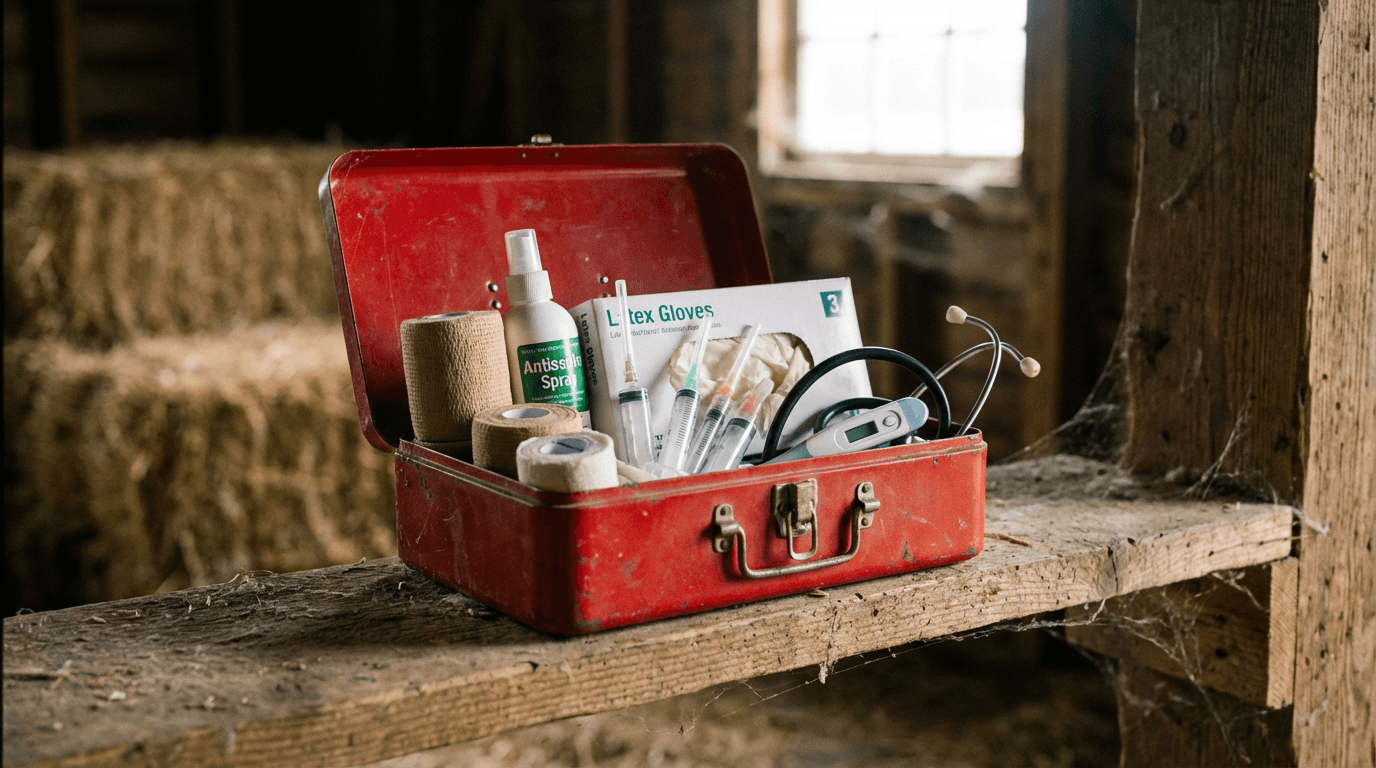
A well-stocked farm first aid kit stored in a clean, dry location you can reach in the dark is one of the most important investments on a working livestock operation. Below is a comprehensive checklist organized by category. Consult your veterinarian about prescription items — many are available under a valid VCPR (Veterinarian-Client-Patient Relationship).
Wound Care and Bandaging
- Sterile saline or wound wash (2–4 bottles, 500 mL each): For flushing wounds. Do not use hydrogen peroxide — it damages healthy tissue.[3]
- Betadine (povidone-iodine) scrub and solution: Dilute scrub to a light tea color for wound cleaning. Solution for foot rot, thrush, and navel dipping.
- Chlorhexidine solution: Broad-spectrum antiseptic, gentle enough for daily wound care.
- Sterile non-stick wound pads (4x4 and 8x8): Primary contact layer over open wounds.
- Rolled gauze (3-inch and 4-inch): Padding and secondary bandage layer.
- Vet wrap / self-adhesive bandage (3-inch and 4-inch): Outer conforming layer. Do not apply too tightly — check distally for swelling.
- Elastic adhesive tape (Elastikon): For securing bandages over hooves and joints.
- Duct tape: Over hoof bandages to waterproof and extend life.
- Sterile gloves (multiple pairs): Protect both you and the animal from cross-contamination.
- Curved and straight hemostats: For clamping bleeding vessels.
- Bandage scissors with blunt tip: For removing stuck bandages safely.
- Wound spray (aluminum-based or antibiotic): For superficial abrasions and hoof care.
Examination and Monitoring Tools
- Digital rectal thermometer (2–3 units): With strings and clips attached.
- Stethoscope: For listening to rumen sounds, heart rate, and lung sounds.
- Flashlight or headlamp (with fresh batteries): Essential for night calls and dark stalls.
- Notebook and pen: Record vitals, times, and treatments before the vet arrives.
- Watch or timer: For counting respiratory and heart rates.
- Pen light: For checking pupillary light reflex and examining oral mucosa.
Fluids and Nutritional Support
- Oral electrolyte packets (cattle and small ruminant formulas): For scouring calves, weak kids, lambs with dehydration.
- Esophageal feeder / calf tube: For tube-feeding weak neonates. Know the correct technique before you need it.
- 60 mL dose syringe (Drenching syringe): Oral medication delivery for goats and sheep.
- Colostrum supplement (frozen or powdered): For newborns that fail to nurse in the first 6 hours.[6]
- Propylene glycol: For ketosis/pregnancy toxemia in cattle, sheep, and goats.
- Calcium borogluconate or calcium gel: For milk fever (hypocalcemia). IV administration requires veterinary guidance.
- Dextrose 50% solution (50 mL): Diluted and given slowly IV for hypoglycemia — under vet direction only.
Medications (discuss with your vet and maintain a VCPR)
- Flunixin meglumine (Banamine): Non-steroidal anti-inflammatory. For pain, fever, colic, mastitis — doses vary by species. Never administer IM to horses — IV only.
- Meloxicam: NSAID, useful in cattle and small ruminants.
- Penicillin G procaine: First-line antibiotic for many bacterial infections. Requires VCPR.
- Oxytetracycline: Broad-spectrum antibiotic for pinkeye, foot rot, pneumonia.
- Epinephrine (1:1000): For anaphylactic reactions post-vaccination. Dose: cattle 5 mL SQ; horses 3–5 mL SQ/IM; goats/sheep 0.5–1 mL SQ.
- Thiamine (vitamin B1): For polioencephalomalacia (goat polio) — a genuine emergency. Give early and often.
- Selenium/Vitamin E: For white muscle disease in deficient areas.
- Probiotic paste: For restoring rumen/gut flora post-antibiotics or illness.
OB and Neonatal Supplies
- OB lube (gallon jug): Water-soluble. You will always need more than you think.
- OB chains (2 sets, long and short) or calving straps: For traction on malpresented fetuses.
- OB handles (2): Work with OB chains to distribute force evenly.
- OB sleeves (box of 25): Shoulder-length for large animal work.
- Calf puller (come-along): For posterior or anterior presentations requiring mechanical traction.
- Iodine 7% teat dip or navel dip: Critical for preventing navel ill in newborns. Dip or spray navel immediately after birth.
- Lamb and kid colostrum replacement: For orphans or dams with agalactia.
- Bulb syringe: Clear airways of newborns.
- Towels (old, rough): For vigorous rubbing to stimulate weak neonates.
Miscellaneous Tools
- Hoof knife and hoof pick: For foot rot and hoof abscess evaluation.
- Hoof block and adhesive: For therapeutic shoeing of cattle with hoof issues.
- Stomach tube and pump (large animal): For rumen decompression and oral medication. Requires practice and proper training.
- Nasogastric tube (equine, 12–16 mm): For colic treatment and mineral oil administration. Vet skill required.
- IV catheter (14g, 18g): For emergency fluid access. Vet-placed, but good to have available.
- Syringes (3 mL, 6 mL, 12 mL, 35 mL) and needles (18g, 20g, 22g): Multiple sizes for injections.
- Dosing chart laminated card: Species weights and drug doses — your vet can help you make this.
- Vet contact numbers: Posted in the barn and saved in your phone. Include after-hours and emergency contacts.
Store your kit in a clean, waterproof container — a large plastic toolbox works well. Inspect it twice yearly and replace expired items. Keep it in a location every family member and farm hand knows.
Wound Care: Assessment, Cleaning, and Bandaging
Livestock wounds range from minor wire cuts to deep lacerations that penetrate joints, tendon sheaths, or body cavities. Your ability to correctly assess the wound and provide immediate care determines how well it heals.
Initial Wound Assessment
Before touching the wound, secure the animal safely. A limping, frightened cow or horse can injure you seriously. Use a halter and lead, a head gate, or a squeeze chute as appropriate. Approach calmly and quietly.
Ask yourself:
- Is there arterial bleeding (bright red, spurting)? This is life-threatening and requires immediate pressure and an emergency vet call.
- How deep is the wound? Does it probe to bone, joint, or tendon sheath? These require immediate veterinary attention — joint infections can be fatal within 24–48 hours.
- Is the wound over a joint? Any wound within 3 cm of a joint surface is a joint emergency until proven otherwise.
- How old is the wound? Fresh wounds (under 6 hours) may be suturable. Old, contaminated wounds require open management.
- Is there soil, organic debris, or hardware (wire, nails) embedded?
Controlling Hemorrhage
Apply firm, direct pressure using the cleanest material available — ideally a sterile gauze pad, but a clean cloth will do. Maintain pressure for a full 5 minutes without lifting to check. If blood soaks through, add more material on top without removing the original layer. Elevate the limb if possible. If bleeding does not slow after 10 minutes of firm pressure, call your vet immediately.
Tourniquets should only be used on distal limbs when hemorrhage is truly uncontrollable and veterinary care is more than 30 minutes away. Note the application time, and release briefly every 15–20 minutes to prevent irreversible tissue damage.[5]
Wound Cleaning Protocol
- Clip hair around the wound edges (1–2 inches) to prevent contamination and improve visualization.
- Flush generously with sterile saline using a 35 mL syringe and an 18-gauge needle to create pressurized irrigation — this physically removes bacteria and debris more effectively than gentle pouring.[3]
- Clean the wound with diluted chlorhexidine (0.05%) or diluted betadine scrub (light tea color). Do not use full-strength iodine or hydrogen peroxide in open wounds.
- Gently remove visible debris with gloved fingers or sterile gauze. Do not probe deeply with instruments unless trained.
- Repeat irrigation at least twice.
- Cover with a non-stick sterile pad, followed by rolled gauze, then vet wrap. Do not wrap so tightly that you occlude blood flow.
When NOT to Suture or Close
Do not attempt to close a wound with staples or sutures unless you are trained and the wound is fresh and clean. Closing a contaminated or old wound traps infection and leads to abscess, dehiscence, and far more serious problems.[3] Your job in first aid is to protect the wound from further contamination, not to close it permanently.
Bandage Maintenance
Change bandages every 24–48 hours initially, or sooner if wet or soiled. Watch for swelling above or below the bandage (indicating it is too tight), heat, or discharge with an odor. All are reasons to call your vet. Wounds on lower limbs in horses can develop exuberant granulation tissue ("proud flesh") — keep these wounds bandaged and consult your vet about topical management.
Bloat in Ruminants: Frothy and Free Gas
Bloat is one of the most dramatic emergencies in cattle, sheep, and goats. The rumen — the large fermentation chamber on the left side of the abdomen — fills with gas faster than the animal can eructate (belch). In severe cases, bloat can kill within 1–2 hours by compressing the diaphragm and causing respiratory failure and cardiovascular collapse.
Frothy Bloat vs. Free Gas Bloat
Frothy bloat (pasture bloat or feedlot bloat) occurs when gas becomes trapped in a stable foam within the rumen, preventing eructation. Common causes: lush legume pasture (alfalfa, clover), rapid diet changes to high-concentrate feeds, wet grass after rain.
Free gas bloat occurs when gas accumulates but cannot escape due to a physical obstruction (esophageal choke) or a failure of the eructation reflex (milk fever, anesthesia, downer cow). The distinction matters because the treatment differs.
Recognizing Bloat
Look for distension of the left paralumbar fossa — the triangular hollow behind the last rib and in front of the hip. In severe bloat, the left side bulges visibly and may feel drum-tight when flicked with a finger. The animal is distressed, may kick at its belly, refuse to eat, breathe with mouth open, and stand with front legs elevated or stretch out.
Emergency First Aid for Bloat
Step 1: Move the animal — walk it slowly if ambulatory. Movement stimulates eructation and may resolve mild free gas bloat.
Step 2: For frothy bloat — administer an anti-foaming agent. Poloxalene (Therabloat) is the drug of choice — follow label dosing. Simethicone (Gas-X, the human product) can be used in goats and sheep as a temporary measure. Mineral oil (1 pint for cattle, 60–120 mL for small ruminants) drenced by mouth can also break foam.
Step 3: Position the animal with front end elevated if it will allow this — elevating the rumen exit facilitates gas escape.
Step 4: If the animal is in severe distress, cannot breathe, and is going down, emergency trocarization of the rumen may save its life. The trocar is inserted in the center of the left paralumbar fossa. This is a last-resort procedure with real risks — do it only if the animal will otherwise die before the vet arrives, and only if you have been trained. Call your vet immediately for guidance.
When to call the vet: Immediately for any bloat that doesn't resolve in 15–20 minutes of walking and treatment, any animal in respiratory distress, or any free gas bloat (which may indicate underlying choke or other obstruction).
Choke in Horses and Cattle
Choke in livestock refers to esophageal obstruction — food material lodged in the esophagus — rather than tracheal obstruction as in humans. The airway is not blocked, so the animal can breathe, but it cannot swallow, is in significant distress, and risks aspiration pneumonia from material refluxed into the nasal passages.
Signs of Esophageal Choke
- Profuse nasal discharge (often food-tinged, green or yellow)
- Retching or repeated swallowing attempts
- Excessive salivation and drooling
- Anxiety, neck stretching, pawing
- In cattle: bloat may develop rapidly as the cow cannot eructate
- In horses: the obstruction may be visible or palpable along the left side of the neck
First Aid for Choke
Keep the animal calm and quiet — excitement worsens the situation. Remove all feed and water immediately. Do not attempt to push the obstruction down with a tube unless you are experienced — improper passage of a stomach tube into an already traumatized esophagus can cause perforation, which is catastrophic.
Many chokes in horses resolve spontaneously within 30–60 minutes as the animal relaxes and the esophagus softens the obstruction. Keep the animal's head down (to allow drainage away from the airway) and call your vet. Do not leave the animal unobserved — aspiration pneumonia and esophageal rupture are serious complications.
Your vet will likely administer sedation, muscle relaxants, and pass a nasogastric tube with water lavage to break up and flush the obstruction. Prognosis is good when treated promptly.
Limb Injuries: Fractures, Luxations, and Tendon Injuries
A suspected fractured limb in a large animal is an extremely serious situation. Unlike dogs and cats, large animals cannot be kept off their feet, and internal fixation sufficient to support their weight is complex, expensive, and not always possible. Your role in first aid is to stabilize, minimize further injury, and support the animal until your vet arrives and a prognosis can be determined.
Assessing the Injury
Observe the animal at rest and note:
- Which leg is affected and where the apparent problem is located (foot, pastern, cannon bone, knee/fetlock, hock, upper limb)?
- Can the animal bear any weight at all? Complete non-weight-bearing is more serious than toe-touching lameness.
- Is there an open (compound) fracture with bone exposed? This significantly worsens prognosis due to infection risk.
- Is there crepitus (grinding or crackling) on gentle palpation?
- Is there abnormal angulation of the limb?
Stabilization Techniques
For fractures of the lower limb (below the knee or hock) in horses, a Robert Jones bandage provides excellent support and padding. Layer from the ground up: foot wrapping, thick padding (cotton or roll cotton), rolled gauze, vet wrap. The bandage should be firm but not constrictive, and thick enough to immobilize the joint above and below the injury. A PVC pipe splint or wooden board can be incorporated into the outside of the bandage for rigid support.
In cattle and small ruminants, the same principles apply, scaled to body size. Goats and sheep with lower-limb fractures can often be stabilized and successfully treated with casting.
Do not:
- Force the animal to walk on a suspected fracture
- Leave a horse with a suspected upper-limb fracture unattended in a stall where it may go down and further injure itself
- Apply a splint so tightly that you cause pressure sores or occlude circulation
Prognosis note: Upper-limb fractures (above the knee or hock) in adult horses and cattle are almost universally unsurvivable. Your vet will counsel you honestly on euthanasia decisions. Humane euthanasia is a valid and kind option when the prognosis is hopeless and suffering is involved.
Tendon and Ligament Injuries
Superficial digital flexor tendon and suspensory ligament injuries ("bowed tendons") are common in horses under hard work. Signs include: sudden onset of lameness, heat and swelling along the back of the cannon bone, pain on palpation. First aid: cold water hosing (15–20 minutes), cold pack, and firm support bandage. No work. Call your vet — ultrasound is the gold standard for diagnosis and prognosis. Early aggressive management improves outcomes significantly.
Dystocia: Difficult Birth Management
Dystocia (difficult birth) is one of the most common emergencies in cattle, sheep, and goats. Prompt intervention is critical — delayed action leads to fetal death, uterine rupture, septicemia, and dam death. Know what normal delivery looks like for each species on your farm so you can recognize when intervention is needed.
Normal Labor Timelines
| Species | Stage 1 (Cervical Dilation) | Stage 2 (Active Labor/Delivery) | Stage 3 (Placenta Expelled) |
|---|---|---|---|
| Cattle | 6–24 hours | 30 min – 4 hours | 12 hours (retained if >12h) |
| Horses | 1–4 hours | 20–30 minutes | 1–3 hours (retained if >3h) |
| Goats | 12–24 hours | 30 min – 2 hours per kid | 30 min – 4 hours |
| Sheep | 12–24 hours | 30 min – 2 hours per lamb | 30 min – 4 hours |
When to Intervene
For cattle: call your vet if the cow is in active straining for more than 30–60 minutes with no progress, or if the water bag is visible but no fetal parts appear within 30 minutes. For goats and sheep: if the doe/ewe is actively pushing for more than 30 minutes with no delivery, investigate.
First Aid for Dystocia
Step 1: Wash the dam's perineum and your hands and arms with warm water and soap. Apply generous amounts of OB lubricant before any internal examination.
Step 2: Gently insert a gloved, lubricated hand to assess the presentation. Normal presentation is two front feet (hooves pointing down) followed by the nose — like a diving position. If you feel only one foot, two back feet (hooves pointing up), a head without feet, or cannot determine the presentation, call your vet immediately.
Step 3: For a normal presentation with a live, responsive fetus that is simply too large, apply OB chains above the fetlock and below the dewclaw. Apply traction only during contractions, matching the cow's effort. Pull downward toward the cow's hocks, not straight out. Alternate pulling one leg ahead slightly of the other to bring the shoulders through one at a time.
Step 4: Once delivered, clear the airway by swinging the calf briefly (supporting the head) or using a bulb syringe. Rub vigorously with a rough towel. Ensure the neonate breathes within 30 seconds.
Do NOT:
- Apply traction on malpresentations you cannot correct
- Use a calf puller without knowing the presentation is correct and the calf is alive
- Pull for more than 30 minutes — you risk uterine rupture
- Leave a retained placenta for more than 12 hours in cattle without veterinary consultation (manual removal requires a vet)
Retained Placenta
A retained fetal membrane in cattle (not expelled within 12 hours) is a veterinary concern due to metritis risk. Do not manually remove it yourself — tearing the placentomes causes hemorrhage and significantly increases infection risk. Your vet may administer oxytocin, intrauterine antibiotics, or systemic antibiotics and allow it to slough naturally. In horses, retained placenta beyond 3 hours is a true emergency due to risk of laminitis and septicemia — call your vet immediately.
Hypothermia: Chilled Newborns and Cold-Weather Emergencies
Hypothermia kills more newborn calves, kids, and lambs in the first 24 hours of life than almost any other cause.[6] Animals born in cold, wet conditions — especially if the dam fails to dry them quickly — can lose body temperature faster than they can generate heat. Learn to recognize it and act fast.
Stages of Hypothermia in Neonates
| Stage | Rectal Temp (°F) | Signs | Action |
|---|---|---|---|
| Mild | 99 – 101 | Shivering, weak suckle reflex, slightly slow | Dry vigorously, warm environment, assist nursing or tube feed colostrum |
| Moderate | 95 – 99 | No shivering, weak, sternal recumbency, won't stand | Warm water bath (102°F), tube feed warm colostrum/electrolytes, warm IV glucose under vet guidance |
| Severe | < 95 | Lateral recumbency, unresponsive, hypothermia | Call vet immediately, warm water bath, IV dextrose — this animal is in critical danger |
Rewarming Protocol for Chilled Calves, Kids, and Lambs
- Dry the animal completely with rough towels — moisture accelerates heat loss dramatically.
- Immerse in a warm water bath (102–104°F) for 20–30 minutes. Keep the head out of the water. This is the fastest way to rewarm a severely chilled neonate. Do not use water that is too hot.
- Dry thoroughly again after the bath — a wet animal placed in a warm room will still chill.
- For mild cases, a heat lamp in a dry, draft-free area is sufficient. Place the lamp 24 inches above the animal and ensure it cannot contact bedding (fire risk).
- Once the rectal temperature exceeds 100°F and the animal is alert, tube-feed warm colostrum. Never tube-feed an animal with a rectal temperature below 99°F — aspiration risk is very high in an obtunded animal.
- A glucose injection (50% dextrose, diluted and given slowly IP or IV) may be necessary for severely hypoglycemic animals — discuss this protocol with your vet in advance for lambing season.
Adult Hypothermia
Adult livestock rarely develop hypothermia unless they are very young, very old, sick, wet, or exposed in extreme conditions without shelter. Wet, windy conditions dramatically increase effective cold stress even at temperatures above freezing. Signs: shivering, huddling, reluctance to move, reduced feed intake. Move to shelter, provide dry bedding, increase caloric density of feed (grain, high-quality hay), and ensure water sources are not frozen.
Heat Stress: Recognition and Emergency Cooling
Heat stress affects productivity before it becomes life-threatening, but in severe cases — particularly in feedlot cattle, gestating ewes during summer, and heavily muscled pigs — it can cause death within hours. Horses exercised in hot, humid conditions can develop exertional heat stroke rapidly.
Temperature-Humidity Index for Cattle
The Temperature-Humidity Index (THI) predicts heat stress risk. A THI above 72 indicates mild stress; above 80 is severe stress. At 84°F with 90% humidity, THI is well into the danger zone. Cattle begin reducing feed intake at mild stress levels and can die of heat stroke at extreme levels.
Signs of Heat Stress
- Mild: Bunching in shade, reduced activity, open-mouth panting, increased water consumption
- Moderate: Continuous panting, drooling, respiration rate above 80/minute in cattle (above 16/minute in horses at rest), huddle in groups for shade
- Severe: Staggering, collapse, cessation of panting (ominous sign), elevated core temperature (>105°F in cattle), seizures, death
Emergency Heat Stress Treatment
- Move the animal immediately to shade and maximum air movement (fans, wind).
- Apply large volumes of cool (not ice cold) water directly to the body — focus on the neck, armpits, flank, and large veins of the inner thigh. Repeat continuously.
- For horses, cool water followed by scraping and re-applying is more effective than leaving water on the skin to warm.
- Do not confine the animal — allow free movement if possible.
- Offer fresh, cool water but do not force consumption.
- Call your vet immediately if the animal collapses, stops panting, or does not improve within 20–30 minutes of cooling.
- IV fluids may be needed for severely affected animals.
Eye Injuries and Pinkeye
Eye injuries and infectious bovine keratoconjunctivitis (IBK, or "pinkeye") are common on livestock operations. Pinkeye is the most common eye disease in US cattle, caused primarily by Moraxella bovis and spread by face flies. Left untreated, it can cause corneal ulceration and permanent blindness within days.
Signs of Eye Problems
- Excessive tearing, squinting, or photophobia (closing eye in light)
- Cloudiness or white opacity in the cornea
- Corneal ulcer (visible crater or defect)
- Purulent (yellow/green) discharge
- Protrusion of the third eyelid
First Aid for Eye Injuries
Flush the eye gently with sterile saline to remove debris. Apply an ophthalmic antibiotic ointment if a corneal scratch is suspected (without signs of deep ulceration). Protect the animal from bright light. A temporary eye patch can reduce irritation. Call your vet for any corneal opacity, deep ulcer, or failure to improve within 24 hours. Oxytetracycline IM or SQ is the first-line treatment for IBK — consult your vet for doses and withdrawal times.
Snakebite
Venomous snakebites — primarily from rattlesnakes, copperheads, and cottonmouths — are a real risk on farms across much of the US. Horses and cattle are most commonly bitten on the nose while grazing or investigating. The bite causes intense local swelling, which in a horse's nasal passage can obstruct breathing within hours.
First Aid for Snakebite
- Keep the animal calm and restrict movement — increased heart rate accelerates venom spread.
- For nasal bites in horses: insert a garden hose or flexible tube (~1 inch diameter) into each nostril to maintain an airway as swelling progresses. Tape lightly in place. Call your vet immediately.
- Do not cut and suck the wound, apply tourniquets, or apply ice — these are ineffective and harmful.
- Your vet may administer antihistamines, NSAIDs, corticosteroids, and supportive care. Antivenom is expensive and not always available but may be warranted in severe cases.
When to Call vs. When to Treat at Home
Knowing when a situation exceeds your skill level and demands immediate veterinary intervention is the most important first aid skill you can develop. The table below is a general guide — always err on the side of calling your vet if you are uncertain.
| Situation | Call Vet Immediately | First Aid + Monitor | Home Manage |
|---|---|---|---|
| Wound, superficial, clean, not near joint | Yes — flush, bandage, monitor | ||
| Wound near a joint or over tendon sheath | Yes | ||
| Active arterial hemorrhage | Yes — apply pressure, call immediately | ||
| Bloat, mild, resolves with treatment | Yes — walk, treat, monitor | ||
| Bloat, severe, animal in distress | Yes | ||
| Choke, esophageal, horse | Yes — within 1 hour if not resolved | ||
| Colic, horse, mild (passes quickly) | Yes — monitor, walk | ||
| Colic, horse, unresponsive to treatment >30 min | Yes | ||
| Suspected fracture, lower limb | Yes — stabilize, call | ||
| Dystocia, malpresentation | Yes | ||
| Dystocia, normal presentation, minor traction needed | Yes — proper technique, call if no progress in 30 min | ||
| Chilled neonate, mild hypothermia | Yes — dry, warm, tube feed | ||
| Chilled neonate, severe hypothermia | Yes | ||
| Heat stroke, collapse | Yes — cool while calling | ||
| Pinkeye, early | Yes — antibiotic treatment, consult vet for script | ||
| Milk fever (down cow after calving) | Yes | ||
| Prolapsed uterus | Yes — this is always an emergency | ||
| Anaphylaxis post-vaccination | Yes — administer epinephrine immediately | ||
| Snakebite, nasal swelling in horse | Yes — airway emergency |
Anaphylaxis: Vaccine Reactions and Allergic Emergencies
Anaphylactic reactions to vaccines, injectable medications, and insect stings can occur within minutes of administration. They are rare but potentially fatal without immediate treatment.
Signs of Anaphylaxis
- Sudden collapse or weakness within minutes of an injection
- Rapid breathing, open-mouth breathing, gasping
- Pale or white mucous membranes
- Profuse sweating (horses)
- Muscle trembling, convulsions
- Urticaria (hives) — raised wheals on skin, especially in horses
- Diarrhea and urination (common in cattle)
Treatment
Administer epinephrine (1:1000) subcutaneously or intramuscularly immediately:
- Cattle: 5–10 mL SQ or IM (dosing by weight, ~1 mL per 100 lb)
- Horses: 3–5 mL IM or SQ — use with caution; cardiac arrhythmias possible
- Sheep/Goats: 0.5–1.0 mL SQ
Call your vet simultaneously. Secondary treatment with dexamethasone and antihistamines (diphenhydramine) may be needed. Keep epinephrine in your refrigerator and check the expiration date every six months.
Milk Fever (Hypocalcemia)
Milk fever most commonly affects high-producing dairy cows within 72 hours of calving, but it also occurs in beef cattle, sheep, and goats at any stage of lactation when calcium demand exceeds supply. It is caused by sudden, massive calcium drain into colostrum and milk production.
Signs
- Stage 1: Excitement, trembling, hypersensitivity, incoordination
- Stage 2: Unable to rise (down cow), cold ears, cool extremities, dry muzzle, neck kinked to side, constipation, reduced heart sounds (quiet, rapid heart)
- Stage 3: Lateral recumbency, unconscious, cold, complete muscle flaccidity — can die within hours
First Aid
Oral calcium gels (Bovikalc, CMPK boluses) are appropriate for Stage 1 or prevention. Do not give oral calcium to a down cow — aspiration risk. IV calcium (calcium borogluconate) given slowly is the definitive treatment and requires veterinary administration. While waiting for your vet: keep the cow sternal (propped in a sitting position), keep her warm, do not milk her out completely (leave some milk — removing all calcium-rich milk worsens the deficit). Call your vet immediately for any down cow post-calving.
Uterine and Vaginal Prolapse
Vaginal prolapse (before birth) and uterine prolapse (after birth) are both emergencies that require immediate veterinary attention. Do not attempt to replace a prolapsed uterus without guidance — improper technique causes tearing, hemorrhage, and death.
First Aid
Keep the prolapsed tissue clean and moist while waiting for your vet. Cover with a clean, wet towel or sheet. If the prolapse is dragging on the ground, gently support it with a clean container or towel sling. Prevent the animal from straining — tenesmus worsens the prolapse. Isolate her from other animals to prevent trampling. Call your vet immediately.
Preparing for Emergencies Before They Happen
Establish a VCPR Before You Need It
A Veterinarian-Client-Patient Relationship (VCPR) is required by law for veterinarians to prescribe medications and provide guidance on treatment protocols. Establish this relationship with a large animal vet before an emergency. Annual farm visits, routine health work, and pre-calving consultations all build the VCPR and give your vet baseline knowledge of your herd or flock.
Create an Emergency Contact Sheet
Post this in your barn, save it to your phone, and give a copy to every person who works with your animals:
- Primary large animal vet — regular hours number
- Primary large animal vet — after hours/emergency number
- Nearest equine or livestock emergency hospital with hours and address
- Poison control: ASPCA Animal Poison Control (888) 426-4435
- Extension livestock specialist for your county
Know Your Animals Baseline
At least once a season, practice taking vital signs on healthy animals. Check temperatures, heart rates, and respiratory rates. Listen to rumen sounds. Record them. The only way to recognize abnormal is to deeply know normal for your animals on your farm.
Run Annual First Aid Drills
Walk through hypothetical scenarios with anyone who works on your property. Where is the kit? How do you apply a Robert Jones bandage? How do you tube-feed a calf? Muscle memory matters when adrenaline is running high at 2 a.m.
Find a Large Animal Vet Near You
All the first aid knowledge in the world has its limits. The right veterinarian, on your farm, within the first hour of a serious emergency, is irreplaceable. Building a relationship with a qualified large animal vet before disaster strikes is the single most important step you can take for the long-term health of your operation.
FarmVetGuide helps US farmers and ranchers find large animal veterinarians by county, with filters for species treated (cattle, horses, goats, sheep, swine, poultry), emergency availability, mobile/farm-call service, USDA accreditation, and more. Search your county now to find the vet nearest to you — and save their number before you need it.
- Find cattle vets near you
- Find equine veterinarians by county
- Find goat vets near you
- Find sheep veterinarians near you
- Find emergency large animal vets
Frequently Asked Questions
What is the most important thing to do in a farm animal emergency?
Stay calm, assess the animal's vital signs, and call your large animal veterinarian immediately. Do not wait to see if the animal improves before calling — early intervention leads to better outcomes in nearly every emergency scenario. Have your vet's after-hours number saved and accessible before you need it.
How do I know if a wound needs stitches?
Wounds that are deep, gaping, longer than 1 inch, over a joint, or involving a limb should be evaluated by your vet for possible suturing. Fresh, clean wounds sutured within 6 hours heal best. Wounds older than 8–12 hours, contaminated wounds, and wounds over joints should be managed as open wounds. When in doubt, call your vet — the cost of a farm call is far less than the cost of an infected wound.
Can I give my cattle Banamine (flunixin meglumine)?
Flunixin meglumine is an effective NSAID for pain and fever in cattle and horses, but it requires a VCPR to legally obtain and use. In cattle, it can be given IV or as an oral granule product. In horses, it should only be given intravenously — IM injection in horses has been associated with severe, potentially fatal clostridial myositis. Always consult your vet for dosing, duration, and withdrawal times before administering any prescription medication.
My goat kid is weak and cold — what do I do first?
Take the kid's rectal temperature immediately. If it is above 100°F and the kid is shivering, dry vigorously and place in a warm environment (heat lamp or warming box). Attempt nursing or tube-feed warm colostrum — 10% of body weight in the first 6 hours is critical for survival. If the rectal temperature is below 100°F, warm the kid first in a warm water bath (102–104°F) before tube-feeding anything. Never tube-feed a hypothermic kid — aspiration pneumonia can result.
How do I know if my cow has milk fever vs. just being tired after calving?
A cow with milk fever typically goes down (cannot rise) within 24–72 hours of calving, has cold extremities, dry muzzle, a kinked neck, and very quiet heart sounds. She is not just tired — she is in a life-threatening hypocalcemic state. A tired cow after calving is usually still standing, alert, and nursing her calf. Any cow that goes down within 3 days of calving should be assumed to have milk fever and treated — call your vet immediately.
What should I do if my horse is colicking?
Remove all feed, walk the horse gently to assess comfort and stimulate gut motility, and call your vet. Monitor heart rate (above 60 bpm is concerning), gut sounds, and whether the horse is able to defecate. Do not administer more than one dose of Banamine without veterinary direction — masking pain without addressing the underlying cause can lead to delayed diagnosis of surgical colic, which is life-threatening. If the horse is in severe pain, rolling violently, or does not respond to initial treatment within 30–45 minutes, this is an emergency requiring immediate veterinary care.
Is it safe to keep epinephrine on my farm?
Yes, and it is highly recommended if you vaccinate animals regularly. Discuss with your veterinarian to obtain epinephrine (1:1000) and a dosing chart for your species. Store it in the refrigerator, check expiration dates every 6 months, and know where it is and how to use it before you give any injection. Anaphylactic reactions post-vaccination can be fatal within minutes — epinephrine administered in the first 1–2 minutes is life-saving.
Sources & References
This guide references peer-reviewed research and guidelines from leading veterinary organizations. All medical information has been reviewed for accuracy against these authoritative sources.
- Virginia Tech Cooperative Extension — Monitoring Livestock Vital Signs (Publication APSC-169). Last accessed March 2026.
- Merck Veterinary Manual — The Fluid Resuscitation Plan in Animals. Last accessed March 2026.
- Merck Veterinary Manual — Initial Wound Management in Animals. Last accessed March 2026.
- University of Minnesota Extension — Basic First Aid for Your Horse and Preparing for Emergencies. Last accessed March 2026.
- Merck Veterinary Manual — Wound Bandages and Dressings. Last accessed March 2026.
- Merck Veterinary Manual — Failure of Transfer of Passive Immunity in Large Animals. Last accessed March 2026.
- Iowa Beef Center — Vital Signs in Animals: What Cattle Producers Should Know. Last accessed March 2026.
Related Articles & Resources
Sources & Further Reading
We cross-check the animal-health information in this guide against these recognized veterinary and government sources. For clinical guidance, consult them directly or speak with a licensed veterinarian.
How this guide is maintained
Animal-health guides on FarmVetGuide are written and maintained by the FarmVetGuide Editorial Team and cross-checked against authoritative veterinary sources, including the AVMA, USDA APHIS, and the Merck Veterinary Manual. This guide is general educational information, not a substitute for professional veterinary diagnosis or treatment. For a sick or injured animal, contact a licensed veterinarian directly.