Horse Wound Care: First Aid, Treatment by Wound Type & When to Call the Vet
By FarmVetGuide Editorial Team · Published April 2026 · Updated March 2026 · Based on verified data from our directory of 9,500+ practices
Horses get hurt. It is one of the defining realities of working with the species. An animal that weighs 1,000 to 1,200 pounds, moves at speed across uneven terrain, lives in close proximity to fencing and other horses, and spends significant time in stalls with hardware and equipment has abundant opportunities to injure itself. The question is never whether your horse will sustain a wound — it is whether you will know what to do when it happens.
Horse wound care sits at the intersection of first aid, veterinary medicine, and practical farm management. Some wounds are straightforward: clean the area, apply a bandage, monitor for infection, and the horse heals uneventfully in two to three weeks. Others look minor but involve structures that determine whether the horse lives or is euthanized. The cut above the knee that drips a few drops of synovial fluid is not "just a cut" — it may be a joint penetration that requires emergency surgery within hours. The laceration that exposes the flexor tendon sheath does not wait for a Monday morning call.
This guide provides a systematic approach to equine wound assessment, first aid, treatment decisions, and aftercare — with a clear framework for the most critical question in wound management: when to call the vet.
Wound Classification: Understanding What You're Dealing With
Before you can make a rational decision about treatment, you need to classify the wound. Not all wounds are equal, and the location, depth, and structures involved matter far more than the size or apparent severity.
Classification by Mechanism
| Wound Type | Mechanism | Characteristics | Key Concerns |
|---|---|---|---|
| Laceration | Tearing force (wire, sharp edge) | Irregular edges, variable depth | Tendon/joint involvement; suturability |
| Incised wound | Sharp object (glass, metal edge) | Clean edges, may be deep | Vascular or tendon injury; good suture candidate |
| Puncture | Nail, wire, splinter, bite | Small surface opening, potentially deep | Underestimates depth; tetanus risk; abscess |
| Abrasion | Friction (rope burn, falling) | Superficial skin loss, large area | Infection; cosmetic outcome |
| Avulsion | Pulling/tearing force | Flap of tissue separated from base | Tissue viability; blood supply to flap |
| Contusion | Blunt trauma | Intact skin over deep bruising/swelling | Underlying structure damage; seroma/hematoma |
| Degloving | Severe avulsion (caught and dragged) | Large area of skin and soft tissue stripped | Emergency; shock risk; requires intensive care |
Classification by Wound Age
Wound age profoundly affects treatment options. The golden window for primary wound closure is generally within 6–8 hours of injury on the body, and some practitioners extend this to 12 hours on the lower limb where contamination risk is high but blood supply is also high. After this window, bacterial contamination and early biofilm formation make primary closure riskier — dehiscence and infection become more likely.
- Fresh (0–6 hours): Best candidate for primary closure if appropriate. Minimal bacterial load, wound edges viable.
- Contaminated (6–24 hours): May still be closed with thorough lavage and debridement; higher infection risk. Delayed primary closure or second-intention healing often preferable.
- Infected (>24 hours with signs of infection): Primary closure contraindicated. Open wound management, lavage, debridement, and staged closure or second-intention healing.
Classification by Location and Depth
Location determines which critical structures are at risk. The lower limb — from the knee (carpus) and hock downward — contains structures that are simultaneously critical (tendons, tendon sheaths, joints, bone) and poorly protected by muscle and subcutaneous fat. A wound that would be straightforward on the neck or barrel becomes a potential career-ending injury on the pastern.
| Location | Critical Structures at Risk | Emergency Indicator |
|---|---|---|
| Coronary band | Coronary corium, coffin joint | Any puncture or deep laceration |
| Pastern region | Coffin joint, digital flexor tendon sheath, pastern joint | Joint or sheath penetration |
| Fetlock | Fetlock joint, digital flexor tendon sheath, suspensory branches | Any wound near joint margins |
| Cannon region | Superficial/deep digital flexor tendons, suspensory ligament | Wound reaching tendon level |
| Knee (carpus) | Carpal joints, carpal sheath, tendons | Any wound near joint; synovial fluid |
| Hock (tarsus) | Tarsal joints (esp. DIT), tarsal sheath, tendons | Any wound near joint; synovial fluid |
| Chest/abdomen | Body cavity penetration possible | Deep punctures; any penetrating wound |
| Head/face | Eye, parotid duct, facial nerve branches | Proximity to eye; deep wounds |
The Field Assessment: What to Do in the First Five Minutes
Your first response to finding a wounded horse should be calm, systematic, and focused. An excited handler communicates anxiety to the horse, making examination and first aid harder. Approach quietly, restrain the horse appropriately — a halter and lead held by a helper is usually sufficient for minor wounds; a lip twitch or mild sedation by a vet may be needed for painful wounds in difficult locations — and begin your assessment.
Control Bleeding First
Arterial hemorrhage — bright red blood spurting in pulses — is a true emergency. Apply direct pressure with the cleanest material available. A folded clean cloth, a sanitary pad, or a stack of gauze held firmly against the wound with hand pressure works. Do not keep lifting the bandage to look — you are disrupting clot formation every time you do. Maintain continuous firm pressure for a minimum of 5 minutes before assessing. Most equine wounds bleed dramatically but are not arterial; venous bleeding (dark red, steady flow) is less urgent but still requires pressure while you assess.
A horse that has lost a significant volume of blood will show pale or white mucous membranes, rapid heart rate (above 50 bpm at rest), rapid respiratory rate, sweating, and weakness. This is a veterinary emergency — control the bleeding and call immediately.
Assess Lameness
Once bleeding is controlled, assess whether the horse is bearing weight on the affected limb. A horse that is completely non-weight-bearing (three-legged lame) from a limb wound has either severe pain or structural compromise — tendon rupture, fracture, or severe joint involvement. This warrants an emergency call regardless of how the wound looks from the surface.
Look for Synovial Fluid
Synovial fluid leaking from a wound is one of the most critical findings in equine wound assessment. Synovial fluid is the lubricating fluid in joints and tendon sheaths. It appears as a clear to pale yellow, slightly viscous fluid — it may drip from the wound edge or pool around the wound margins. When synovial fluid is present, the joint or tendon sheath has been penetrated. Septic arthritis or septic tenosynovitis kills horses or destroys their usefulness. Call the vet immediately and tell them you believe you have synovial fluid. Do not apply antibiotic ointment or powder into the wound — you may interfere with culture results and introduce foreign material into a synovial cavity.
Do Not Probe the Wound
Resist the urge to probe a puncture or deep wound with a finger, stick, or instrument. Probing can push contamination deeper, introduce organisms into sterile structures, and give you a false sense of the wound's true depth. Leave that to a veterinarian with proper instruments and sterile technique.
First Aid Steps: What to Do Before the Vet Arrives
After your initial assessment, your goals are to control bleeding, reduce further contamination, limit movement, and have the horse ready for veterinary examination. Here is a practical protocol:
Step 1: Wound Lavage
If the wound is not near a joint or tendon sheath, gentle lavage with clean water removes debris and reduces bacterial load. A garden hose on low pressure or a large syringe (60 mL) attached to a soft catheter tip delivers water at an appropriate pressure (approximately 8 psi) to clean without driving bacteria deeper. Do not use high-pressure water — it damages tissue and pushes contamination in.
Sterile saline (0.9% NaCl) is ideal but tap water is acceptable in the field. Dilute chlorhexidine solution (0.05% — this is a 1:40 dilution of 2% stock) or dilute betadine solution (0.1–0.5% povidone-iodine — a 1:10 to 1:100 dilution of 10% stock) can be used for lavage. At higher concentrations, both chlorhexidine and betadine are cytotoxic and impair healing — this is a common mistake. The wound should smell faintly of antiseptic, not strongly. Do not lavage wounds near joints or tendon sheaths without veterinary guidance.
Step 2: Bandaging
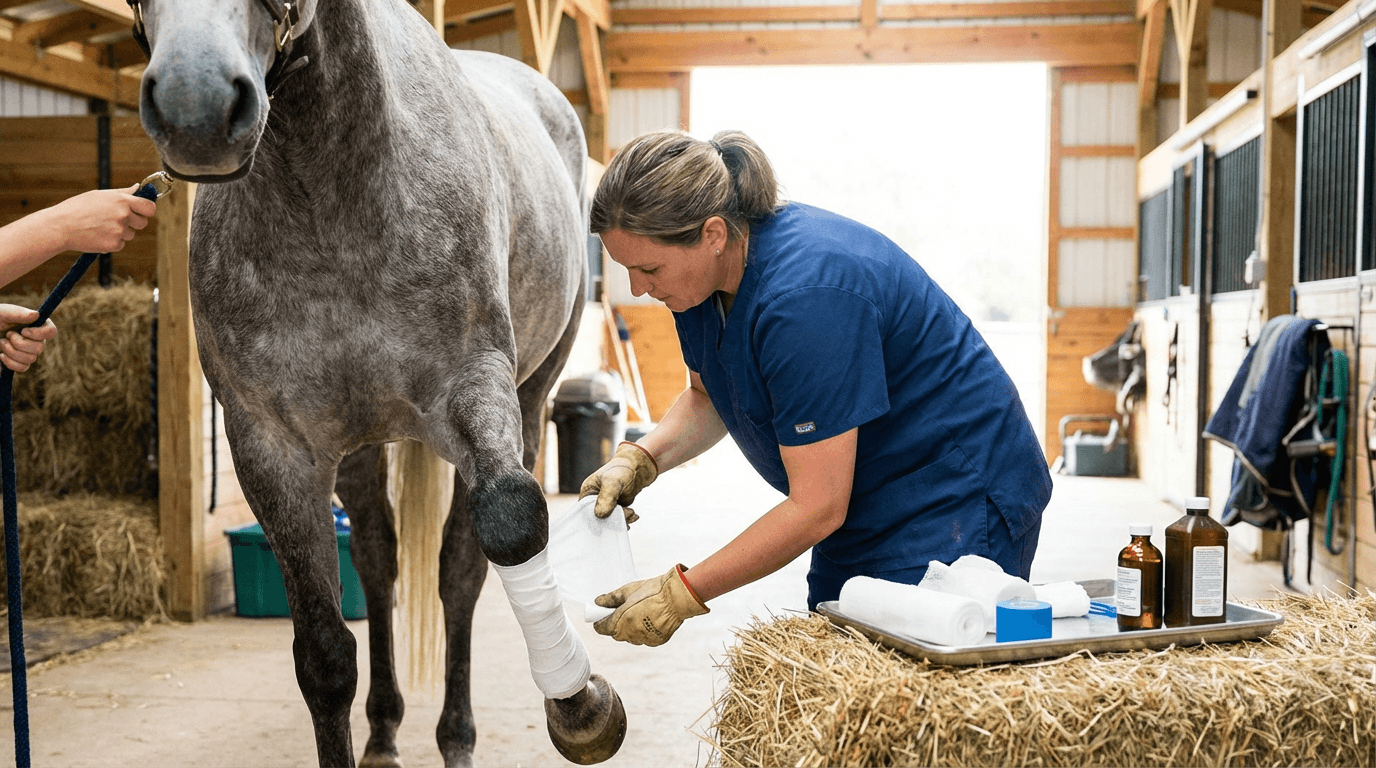
A clean, well-applied bandage protects the wound from further contamination, reduces swelling through gentle compression, and keeps the horse more comfortable while waiting for veterinary care. For limb wounds, the standard field bandage consists of:
- A non-adherent primary layer over the wound (Telfa pad, Release pad, or petroleum gauze)
- An absorbent secondary layer (rolled gauze, combine bandage, or sheet cotton)
- A cohesive tertiary layer (Vetrap, CoFlex) applied with moderate tension — enough to stay in place without cutting off circulation
Bandage too loose and it slides, bunches, and provides no protection. Bandage too tight and you create a pressure sore or impair circulation. The test: you should be able to slide two fingers under the top edge of the completed bandage. A finished lower-limb bandage should extend from just below the knee or hock to encompass the coronary band, with padding adequate to distribute pressure evenly.
Step 3: Limit Movement
Confine the horse to a stall. Movement increases bleeding, disrupts clot formation, drives contamination deeper into wounds, and puts more stress on damaged structures. If you are at a trail head or away from your home facility, use the trailer as temporary confinement.
Step 4: Do Not Give Medications Without Veterinary Guidance
The exception: if you cannot reach a vet within a few hours and the horse is in significant pain, a single dose of oral phenylbutazone (bute) — 2.2 mg/kg, typically 1 gram per 450 kg horse — is reasonable for pain management. NSAIDs can also reduce local inflammation and swelling. But do not administer antibiotics without veterinary direction, and do not apply topical antibiotics to wounds where joint or tendon sheath penetration is suspected.
The Suture Decision: Which Wounds Can Be Closed
Not every wound should be sutured. The decision involves wound age, location, contamination level, tissue viability, tension on closure, and the horse's intended use.
Good Suture Candidates
- Fresh wounds (under 6–8 hours old) with clean, viable edges
- Wounds in areas with minimal tension and good blood supply (upper limb, shoulder, neck, body)
- Incised wounds with clean linear edges
- Facial wounds where cosmetic outcome matters and blood supply is excellent
- Wounds over joint regions where protection of the joint from environment is critical (even if the joint is not penetrated)
Poor Suture Candidates
- Wounds on the lower limb below the knee or hock — high tension, poor blood supply, constant movement impair closure success. These are often better managed by second-intention healing.
- Contaminated or infected wounds
- Wounds with necrotic (dead) tissue that requires debridement
- Avulsions where the skin flap has lost its blood supply
- Wounds with significant skin loss — you cannot close what is not there
Second-Intention Healing on the Distal Limb
Second-intention healing — allowing a wound to fill in with granulation tissue, contract, and epithelialize from the edges without surgical closure — is the standard approach for many lower limb wounds in horses. With appropriate wound management (regular bandage changes, debridement of excess granulation tissue, protection from contamination), horses can heal wounds that would be surgically closed in other species.
The timeline is measured in weeks to months depending on wound size and location. A wound involving 4–6 cm of skin on the cannon bone may take 8–12 weeks to heal fully. During this time, bandage changes are typically done every 2–4 days initially, tapering to twice weekly as the wound progresses through granulation and epithelialization phases.
Proud Flesh: The Equine Wound's Worst Enemy
Proud flesh — exuberant granulation tissue, or equine exuberant granulation tissue (EGT) — is the most common complication of wound healing on the lower limb of horses. It occurs when granulation tissue (the pink, glistening "healing" tissue that fills a wound) overgrows the wound margins and rises above the level of the surrounding skin, preventing epithelial cells from migrating across its surface to complete healing.
Once proud flesh is established, the wound will not heal without intervention. The surface epithelium cannot climb up and over the mass of granulation tissue. Meanwhile, the mass continues to grow, becomes increasingly vascular and fragile (bleeds easily with minor trauma), and can become infected.
Why Horses Are Different
Horses are uniquely predisposed to EGT on the distal limb. The reasons are not fully understood but appear to involve differences in skin tension, movement at the wound site (every step moves the skin over the cannon and pastern), and possibly differences in the local inflammatory response compared to other species. Wounds on the trunk and upper limb heal by second intention with far less prone to EGT.
Preventing Proud Flesh
Prevention is far easier than treatment. Key strategies include:
- Early bandaging: Consistent, well-applied bandages apply gentle compression that restricts granulation tissue overgrowth. Bandaging the wound from the beginning and maintaining it through the granulation phase is the single most effective prevention strategy.
- Limit movement: Stall rest during the healing period reduces motion at the wound site, which stimulates granulation tissue formation. Horses on pasture with lower limb wounds develop proud flesh more frequently.
- Control local inflammation: Topical or systemic anti-inflammatory treatment reduces the inflammatory stimulus driving exuberant granulation. Betamethasone-containing ointments applied to wound margins (not into the wound) can help in some cases.
- Appropriate wound dressings: Some dressings actively reduce granulation tissue. Hydrogel dressings, foam dressings, and certain silver-containing dressings create a moist wound environment that promotes epithelialization without stimulating excessive granulation. Your veterinarian can recommend appropriate products.
Treating Established Proud Flesh
Established proud flesh requires debridement — cutting back the granulation tissue to the level of the surrounding skin. This does not require anesthesia because granulation tissue has no pain sensation (it contains no nerve endings). A scalpel, sharp scissors, or in some cases electrocautery is used. The horse is typically restrained with a lip twitch and may receive acepromazine or detomidine for sedation. After debridement, bandaging is resumed.
Caustic products marketed for proud flesh control — copper sulfate powder being the most common — work by chemically burning the granulation tissue. They also burn healthy tissue and the delicate epithelium migrating from the wound edges. Caustic products should be used judiciously and only at the surgeon's direction; indiscriminate use delays healing. Dilute copper sulfate applied carefully to the proud flesh surface only (not to skin edges) can be effective in the hands of an experienced practitioner.
Severe or recurring proud flesh may require skin grafting. Pinch grafts (small plugs of skin harvested from a donor site on the horse's neck or chest) can be placed across the wound surface to accelerate epithelialization and reduce healing time by months. This is done under sedation and local anesthesia and can often be performed in the field by a veterinarian experienced with the technique.
Tetanus: The Hidden Risk in Every Wound
Clostridium tetani — the bacterium that causes tetanus — is ubiquitous in soil and horse manure environments. It is an anaerobic organism that thrives in deep, narrow wounds with reduced oxygen, exactly the type created by punctures, wire wounds, and foreign body penetrations. Horses are among the most susceptible domestic animals to tetanus. Without treatment, tetanus in horses is fatal in the majority of cases.
The disease progresses from facial muscle stiffness (the "lockjaw" of classical descriptions), to generalized muscle rigidity, to violent tetanic spasms triggered by noise or touch, to respiratory failure. Horses develop a characteristic "sawhorse" stance, extended neck, flared nostrils, and protrusion of the third eyelid. Death occurs within days in severe cases.
Prevention: The Vaccination Protocol
Tetanus toxoid vaccination is highly effective and inexpensive. The standard protocol:
- Primary series: Two doses of tetanus toxoid, 4–6 weeks apart
- Booster: Annual booster thereafter
- Wound booster: Any horse that sustains a wound of concern should receive a tetanus toxoid booster if vaccination status is current, OR tetanus antitoxin (TAT) if vaccination status is unknown or lapsed — along with starting a new toxoid series
- Foals: Begin primary series at 4–6 months in foals from vaccinated mares; vaccinate at 1–2 months in foals from unvaccinated or unknown mares
When Vaccination Status Is Unknown
Any horse with an unknown vaccination history that sustains a wound should receive tetanus antitoxin (TAT) — passive immunity that provides 2–3 weeks of protection. TAT carries a small risk of serum hepatitis (Theiler's disease) in horses, so it is not given routinely to vaccinated horses. But in the face of a contaminated wound and unknown vaccination history, the risk of tetanus outweighs the risk of TAT. Begin a toxoid series simultaneously to establish active immunity.
Wound Care by Body Region
Lower Limb Wounds (Below Knee or Hock)
These are the highest-stakes wounds in equine medicine. The concentration of critical structures — digital flexor tendons, suspensory ligament, digital flexor tendon sheath, navicular bursa, and multiple joints — in a region with thin skin coverage and minimal soft tissue padding means that even a seemingly minor wound can have catastrophic implications.
Any wound in this region that creates a question about joint or tendon sheath penetration requires same-day veterinary evaluation. The test for synovial penetration involves injecting sterile saline into the joint or sheath and watching whether it exits through the wound — a definitive but not always necessary test if clinical signs are clear. Arthrocentesis of the suspect synovial structure, combined with cytology showing elevated white blood cell count and protein in the fluid, confirms septic involvement.
Septic arthritis treatment is intensive: repeated joint lavage under general anesthesia, systemic high-dose antibiotics, regional limb perfusion (delivering antibiotics directly to the limb via intravenous catheter with a tourniquet in place), and prolonged hospitalization. Despite aggressive treatment, the prognosis for soundness is guarded to poor depending on which structures are involved and how quickly treatment began. Time to treatment is the most important prognostic factor — outcomes deteriorate dramatically for each hour of delay past 8 hours.
Coronary Band Wounds
The coronary band is the tissue at the top of the hoof from which the hoof wall grows. Damage to the coronary corium — the germinal layer — results in permanent defects in hoof wall growth: horizontal grooves, notches, or areas of abnormal hoof wall that persist for the life of the horse. Even relatively minor lacerations at or through the coronary band warrant careful veterinary evaluation and precise repair to minimize cosmetic and functional damage.
Deep wounds at the coronary band may penetrate the coffin joint. The coffin joint sits surprisingly high — higher than the hoof-pastern junction appears from the outside — and is accessible through wounds that look superficially like coronary band lacerations. Synovial fluid from a coffin joint penetration may emerge at the coronary band or through the wound itself.
Hoof Punctures
A nail or other object penetrating the solar surface of the foot is a classic emergency. The concern is penetration of the navicular bursa (located in the caudal third of the foot, beneath the frog) or the coffin joint. The navicular bursa communicates intimately with the deep digital flexor tendon and its sheath — infection here can destroy the tendon and be rapidly life-threatening to the horse's soundness.
If you find a nail or object in the foot, the temptation is to remove it immediately. Resist this if possible. Photograph the foot with the object in place to document its location and angle — this guides the veterinarian's assessment of what structures it may have penetrated. If the horse is in acute distress or you must move it a significant distance, you may need to remove the object, but document its length and angle first.
Hoof punctures in the central and caudal third of the foot — the danger zone — require radiographs and potentially contrast radiography (injecting contrast into the bursa or tendon sheath to see if it communicates with the wound) to assess penetration. Treatment for navicular bursa or coffin joint sepsis involves aggressive surgical lavage, usually at a referral hospital.
Chest and Abdominal Wounds
Penetrating wounds to the chest or abdomen require immediate veterinary evaluation regardless of apparent severity. A chest wound that enters the pleural space can cause pneumothorax — air accumulates in the chest cavity and prevents the lungs from expanding. If you hear a sucking sound at a chest wound, seal it with your hand, a clean cloth, or an occlusive dressing (petroleum gauze if available) and call the vet while maintaining the seal.
Abdominal penetration may not be immediately obvious from the external wound. A horse that sustains a kick or puncture wound to the flank and develops colic signs hours later should be assessed urgently for abdominal penetration or intestinal injury.
Head and Eye Wounds
Wounds near the eye require urgent veterinary evaluation. The eye itself is at risk from direct trauma, penetrating foreign bodies, and infection. Even relatively minor-appearing eyelid lacerations may involve the conjunctiva, cornea, or globe. Periocular wounds should be evaluated by a veterinarian before any lavage or treatment, as improper management can worsen ocular injuries.
The parotid duct runs over the jaw and cheek — damage causes a persistent salivary fistula (a tube of tissue creating a persistent opening through which saliva drains externally) that is difficult to repair. Wounds near the angle of the jaw warrant attention to this structure.
Bandaging Technique: Getting It Right
The bandage is your primary therapeutic intervention between veterinary visits, and a poorly applied bandage creates problems rather than solving them. Bandage rubs, cast sores, pressure necrosis, and bandage bows (superficial digital flexor tendon damage from tight bandaging) are all real complications of improper technique.
The Standard Lower-Limb Wound Bandage
Materials needed:
- Non-adherent wound contact layer (Telfa pads, Release dressing, or petroleum-impregnated gauze)
- Rolled gauze (4-inch width for adult horses)
- Combine pad or sheet cotton for padding (at least 1–2 inches of padding circumferentially)
- Cohesive bandage (Vetrap or equivalent), 4-inch width
- Elastic adhesive bandage (Elastikon) for securing edges (optional but helpful)
Application technique:
- Apply the non-adherent wound contact layer directly over the cleaned wound.
- Wrap rolled gauze over the contact layer in a spiral pattern from distal to proximal, with 50% overlap on each pass. Ensure even tension throughout — no lumps or gaps.
- Apply the combine pad or cotton layer over the gauze in a smooth, even layer. This padding distributes pressure and provides cushioning. Minimum thickness: 1 inch all the way around.
- Apply the cohesive bandage from distal to proximal in a spiral pattern, maintaining even tension. Tension should be firm but not tight. Check by sliding two fingers under the proximal edge.
- For coronary band protection, the bandage should fold down over and cover the coronary band — wounds at or near the coronary band require this. Use Elastikon to secure the distal edge to the hoof wall.
Bandage Change Frequency
| Phase | Typical Change Frequency | Indicators to Change More Frequently |
|---|---|---|
| Acute (days 1–7) | Every 24–48 hours | Strike-through (fluid soaking through outer layer), odor, lameness change |
| Granulating (days 7–21) | Every 2–3 days | Proud flesh development, wound deterioration |
| Epithelializing (weeks 3+) | Every 3–5 days | Wound re-opening, infection signs |
| Near-healed | Weekly or as needed | Any breach in integrity |
Wound Medications and Topical Treatments
The equine wound care market is saturated with products, many of which are ineffective or counterproductive. Guideline: if it is not something you would put on human skin and expect a benefit, reconsider whether it belongs on a horse wound.
What Works
- Dilute chlorhexidine (0.05%): Effective broad-spectrum antiseptic for wound lavage. Does not impair healing at this concentration.
- Dilute betadine (0.1–0.5%): Effective antiseptic at dilute concentrations. Stronger solutions are cytotoxic.
- Silver sulfadiazine cream (SSD): Excellent for contaminated or infected wounds; broad antimicrobial spectrum, moist wound environment, does not impair healing significantly.
- Hydrogel dressings: Maintain moist wound environment, reduce granulation tissue overgrowth, and promote epithelialization. Particularly useful in the mid-granulation to epithelialization phase.
- Manuka honey: Has legitimate antimicrobial properties and creates an osmotic environment that reduces bacterial burden. Use medical-grade manuka honey, not grocery store honey.
- Nitrofurazone (Furacin): Historical standard in horse wound care. Effective as an antimicrobial vehicle but not significantly superior to simpler approaches and has some cytotoxicity at higher concentrations.
What to Avoid or Use Cautiously
- Full-strength betadine or chlorhexidine: Cytotoxic. Kills bacteria but also kills the fibroblasts and epithelial cells doing the healing. Always dilute.
- Hydrogen peroxide: Ineffective as a wound antiseptic, cytotoxic to healing tissue. Not recommended for wound care.
- Caustic powders (copper sulfate, gentian violet, Wonder Dust): Stimulate proud flesh when used liberally. Limited appropriate use cases under veterinary supervision.
- "Wound spray" products with petroleum base: Petroleum-based sprays coat the wound surface and trap bacteria. They are occlusive in a way that impairs, not aids, healing.
- Bag Balm and similar products: Appropriate for dry, cracked skin; not ideal for wounds. Create a semi-occlusive environment that can trap bacteria.
Systemic Treatment: Antibiotics and NSAIDs
Antibiotics
Not all wounds require systemic antibiotics. Simple lacerations in otherwise healthy horses with good vascular supply, managed with appropriate lavage and bandaging, often heal without antibiotic support. Indications for systemic antibiotics include: wound contamination with manure or soil, joint or tendon sheath penetration (mandatory), wounds requiring surgical closure under less than ideal conditions, immunocompromised horses, and wounds showing clinical signs of infection (purulent discharge, expanding cellulitis, fever, increasing lameness).
Common antibiotic choices for equine wound management:
| Antibiotic | Route | Spectrum | Common Use Case |
|---|---|---|---|
| Trimethoprim-sulfamethoxazole (TMS) | Oral | Gram-positive, some Gram-negative | First-line for routine wound infection; convenient |
| Procaine penicillin G | IM injection | Gram-positive (esp. streptococci, clostridia) | Anaerobic contamination; clostridial wounds |
| Gentamicin | IV or regional perfusion | Gram-negative | Regional perfusion for joint/tendon infections |
| Enrofloxacin | IV or oral | Broad-spectrum | Serious infections; resistant organisms |
| Metronidazole | Oral | Anaerobes | Combination therapy for anaerobic infections |
All antibiotics in horses require a valid VCPR and veterinary prescription. Resistance is an increasing concern in equine practice — culture and sensitivity testing from infected wounds guides antibiotic selection and avoids empirical use of broad-spectrum drugs when narrower choices would work.
NSAIDs
Phenylbutazone (bute) is the standard equine NSAID for wound-related pain and inflammation. Typical dosing is 1–2 grams twice daily for adult horses; dose should be tapered as pain resolves. Flunixin meglumine (Banamine) is preferred for visceral pain (colic) but also used for wound-related inflammation. Meloxicam is an alternative with potentially less GI irritation for long-term use.
NSAIDs should be used at the lowest effective dose for the shortest effective duration. Long-term NSAID use in horses causes gastric ulceration (right dorsal colitis, gastric squamous ulcers) and renal papillary necrosis. Always administer NSAIDs with access to free-choice water and, for long-term use, consider concurrent gastric protectant therapy (omeprazole).
Regional and Seasonal Wound Patterns
Where you farm and what season it is influences the types of wounds your horses are most likely to sustain and the complications most likely to arise.
Regional Considerations
Southeastern states: High humidity and heat create environments where wounds heal more slowly, proud flesh develops more aggressively, and secondary infections establish faster. Fly pressure is intense April through October — fly larvae (maggots) can infest wounds within hours of exposure. Fly strike (myiasis) in a wound requires urgent treatment: physical removal of larvae, thorough lavage, and wound coverage. Fly repellent applied to the area around (not in) the wound is part of warm-season bandaging in this region.
Northeastern and upper Midwest: Cold winters affect wound healing — circulation to the distal limb is reduced in cold temperatures, which slows granulation and epithelialization. Horses kept in icy conditions sustain more slipping injuries with lacerations and avulsions. Ice on frozen water sources is a common cause of knee and fetlock lacerations.
Arid West: Desert soils are heavily contaminated with environmental organisms including Coccidioides (though rarely a wound issue) and various Clostridium species. Puncture wounds in sandy, dry soils require attention to anaerobic contamination. Low humidity actually aids wound healing in some respects — desiccation of the wound surface is managed with appropriate moist dressings.
Seasonal Patterns
| Season | Common Wound Types | Key Considerations |
|---|---|---|
| Spring | Barbed wire lacerations (pasture turnout after winter); kick wounds (herd dynamics during turnout) | Inspect fence lines before turnout; tetanus boosters current? |
| Summer | Fly-related wound complications; rope burns; abrasions | Fly control critical; wounds heal faster in warmth; proud flesh risk in humid areas |
| Fall | Trailer-related injuries (hunting/show season); foot punctures from acorns/sticks on trail | Inspect trailer flooring and dividers; carry first-aid kit on trail rides |
| Winter | Ice-related slipping injuries; wire injuries (ice covers fence); slower healing | Blanket checks can reveal wounds; supplement heating for distal limb bandages in extreme cold |
Building a Horse First-Aid Kit for Wounds
Every horse operation — whether one horse on a small property or fifty horses on a working farm — should maintain a well-stocked first-aid kit specifically for wound management. The kit should be in a known location, accessible to all people on the property, and restocked promptly when supplies are used.
Essential Wound Care Supplies
- Non-adherent wound dressings (Telfa pads, 4x4 and 4x8 inch)
- Rolled gauze, 4-inch width (minimum 6 rolls)
- Sheet cotton or combine pads for leg padding
- Cohesive bandage (Vetrap), 4-inch (minimum 6 rolls)
- Elastic adhesive tape (Elastikon), 3-inch
- 60 mL catheter-tip syringe for wound lavage
- Chlorhexidine scrub and solution (for dilution)
- Betadine (povidone-iodine) solution
- Silver sulfadiazine cream
- Sterile saline or clean water for lavage
- Sharp scissors (bandage scissors)
- Exam gloves
- Digital thermometer
- Sterile gauze sponges (4x4 inch, 10-pack minimum)
- Phenylbutazone (bute) paste or powder
- Wound spray (optional)
- Flashlight or headlamp
- Veterinarian's phone number prominently posted
Cost Expectations: Equine Wound Care
| Service/Procedure | Approximate Cost | Notes |
|---|---|---|
| Farm call (emergency) | $100–$300 | Varies by region; after-hours premium |
| Wound evaluation and lavage | $75–$200 | Included in farm call or add-on |
| Wound suture (simple) | $150–$500 | Depends on number of sutures and location |
| Wound suture (complex/deep) | $400–$1,200 | Multiple layers, specialized closure |
| Arthrocentesis (joint tap) | $150–$350 per joint | Includes cytology and culture |
| Joint lavage (standing) | $300–$700 | Field procedure under sedation |
| Joint lavage (under GA) | $1,500–$4,000+ | Referral hospital; arthroscopic preferred |
| Regional limb perfusion | $150–$400 per treatment | Often repeated daily for 3–5 days |
| Proud flesh debridement | $100–$300 per session | May require multiple sessions |
| Pinch skin grafting | $300–$800 | Field procedure; reduces healing time significantly |
| Radiographs (4 views) | $150–$400 | On farm; hospital cost higher |
| Bandage materials (owner-managed) | $15–$40 per change | Frequency varies with wound phase |
The economics of equine wound care can be significant. A joint penetration requiring hospital management can run $5,000–$15,000 or more — and may still result in a horse that is permanently lame. Equine major medical insurance is worth serious consideration for horses of significant monetary or replacement value. Even horses of modest monetary value represent years of training and relationship that cannot be easily replaced. Insurance premiums vary by horse value, deductible, and coverage terms; typical major medical coverage for a horse valued at $10,000 runs $400–$800 per year.
Find a Large Animal Vet Near You
Equine wound management is not a field where trial and error serves your horse well. Early veterinary involvement — assessment of joint and tendon sheath involvement, proper wound classification, appropriate closure decisions, and accurate tetanus protocol — makes the difference between a wound that heals cleanly and one that ends a horse's career or life.
Having an established relationship with an equine veterinarian before you have an emergency means you have a phone number to call at midnight when your horse comes in from the pasture with a wire laceration, a professional who knows your animals and can prioritize your call, and a VCPR in place that allows appropriate prescription and treatment.
FarmVetGuide makes it easy to find equine and large animal veterinarians across all 50 states. Search by county, filter for emergency availability, and identify practitioners with mobile farm-call capability. The directory includes USDA-accredited equine veterinarians, practitioners who specialize in sport horses, and large-animal vets who manage working horses and draft breeds. Use FarmVetGuide to find and save your veterinarian's contact information before you need it.
Frequently Asked Questions About Horse Wound Care
How do I know if my horse's wound has hit a joint?
The clearest sign is synovial fluid leaking from the wound — a clear to pale yellow, slightly viscous fluid that may drip steadily from the wound edges. A horse that is completely non-weight-bearing on the affected limb from a wound injury also warrants immediate concern. Wounds near joints — the fetlock, knee, hock, pastern, or coronary band — should always be evaluated by a veterinarian, even if synovial fluid is not visible. Sterile saline injection into the adjacent joint by a veterinarian can confirm or rule out penetration definitively.
Should I leave a wound open or bandage it?
Bandage it. Wounds on the lower limb should be bandaged from the start. Moist wound healing (maintained by an appropriate bandage) significantly outperforms dry wound management in speed of healing and quality of the final result. The bandage also reduces proud flesh formation through gentle compression and protects against contamination. The only wounds that should consistently be left open are minor abrasions on the trunk or upper body that are not amenable to bandaging and are not at risk for proud flesh.
When is a wound bad enough to need a vet?
Call a vet for any wound that: appears to involve a joint, tendon, or tendon sheath (or is near enough to one that you cannot be sure); causes complete non-weight-bearing lameness; has significant skin loss or tissue damage; is on the coronary band; involves the eye or is very close to it; penetrates the chest or abdomen; is a hoof puncture in the central or caudal foot; or shows progressive swelling, heat, pain, or purulent discharge consistent with infection. When in doubt, call. A quick phone consultation can help you triage whether you need emergency care or can wait until morning.
How long does it take for a horse wound to heal?
Healing time depends entirely on wound size, location, depth, and whether complications develop. Simple lacerations on the upper body or neck sutured promptly may heal within 2–3 weeks. Lower limb wounds managed by second-intention healing typically take 6–16 weeks, sometimes longer for large wounds. Wounds complicated by proud flesh, infection, or joint involvement take longer and may result in permanent scarring, hair color changes over the healed area, and variable degrees of scarring contraction.
What should I do if my horse steps on a nail?
Do not panic, but act urgently. If the nail is still in the foot, photograph its location before removing it — location (tip, sole, heel, frog) determines risk to deep structures. Document the nail's depth and angle. Remove the nail to prevent further migration, then clean the hole with dilute betadine, apply a wet-to-dry bandage covering the sole, and call your veterinarian immediately. Any nail penetrating the caudal third of the foot (beneath the frog) must be treated as a potential navicular bursa or coffin joint penetration until proven otherwise.
How do I prevent proud flesh?
Consistent, correctly applied pressure bandaging from the start of wound management is the most effective prevention. Keep the horse confined to reduce movement at the wound site. Keep the wound moist with appropriate dressings. Avoid caustic topical products during the granulation phase. Have your veterinarian assess the wound at the first bandage change — early identification of developing proud flesh, before it becomes established, allows simple management with light debridement or bandage modification rather than more invasive intervention later.
Does my horse need antibiotics for a wound?
Not every wound requires systemic antibiotics. Simple, clean lacerations in healthy horses managed with appropriate lavage and bandaging often heal without antibiotics. Antibiotics are indicated for joint or tendon sheath penetration (always), heavily contaminated wounds, wounds requiring surgical closure under non-ideal conditions, and wounds showing clinical signs of infection. Your veterinarian will assess the wound and determine whether antibiotic therapy is appropriate. All antibiotics for horses require a prescription — another reason to have an established VCPR with a local equine veterinarian.
Related Articles & Resources
Sources & Further Reading
We cross-check the animal-health information in this guide against these recognized veterinary and government sources. For clinical guidance, consult them directly or speak with a licensed veterinarian.
How this guide is maintained
Animal-health guides on FarmVetGuide are written and maintained by the FarmVetGuide Editorial Team and cross-checked against authoritative veterinary sources, including the AVMA, USDA APHIS, and the Merck Veterinary Manual. This guide is general educational information, not a substitute for professional veterinary diagnosis or treatment. For a sick or injured animal, contact a licensed veterinarian directly.