
Cattle Foot Rot: Causes, Treatment, Prevention & When to Call the Vet
By FarmVetGuide Editorial Team · Published March 2026 · Updated March 2026 · Based on verified data from our directory of 9,500+ practices
Cattle foot rot — known clinically as infectious pododermatitis — is one of the most economically damaging lameness conditions affecting beef and dairy herds across the United States. A single case can cost a producer anywhere from $75 to over $400 in lost production, treatment costs, and labor, and an untreated herd problem can devastate your operation's profitability within a single grazing season.[2] Yet foot rot is largely preventable, and when it does strike, early treatment is remarkably effective. This guide walks you through everything you need to know: what causes foot rot, how to recognize it quickly, which antibiotics work best, how to build a footbath program that actually delivers results, and — critically — when a case has progressed far enough that you need to pick up the phone and call your large animal vet immediately.
What Is Cattle Foot Rot? Understanding the Disease
Foot rot is a bacterial infection of the soft tissue between the claws of the bovine hoof. Despite its name, it is not a condition caused by fungi or simple environmental decay — it is driven by a specific combination of bacteria that invade through damaged skin, particularly the interdigital skin (the tissue bridging the two toes).
The Causative Organisms
The primary pathogen is Fusobacterium necrophorum, a gram-negative anaerobic bacterium that lives naturally in the soil and in the rumen contents of cattle.[1] By itself, F. necrophorum struggles to establish infection unless it has a partner. That partner is most commonly Porphyromonas levii (formerly classified under Bacteroides melaninogenicus), which produces enzymes that help breach the skin barrier and suppress the immune response, giving F. necrophorum the foothold it needs.
Additional opportunistic organisms — including Prevotella species, Bacteroides species, and Trueperella pyogenes — are frequently cultured from advanced lesions and contribute to tissue destruction and abscess formation. When T. pyogenes is heavily involved, the infection tends to be more severe and less responsive to standard antibiotic courses.
How Infection Establishes Itself
Healthy interdigital skin is a highly effective barrier. Infection requires a breach — and that breach typically comes from one of several sources:
- Mechanical trauma: Rocks, frozen ground, stubble, wire fragments, and rough concrete all create small cuts and abrasions that bacteria exploit.
- Prolonged moisture exposure: Wet conditions macerate (soften) the interdigital skin, making it far more permeable to bacterial invasion. Muddy feedlots, waterlogged pastures, and poorly drained barn alleys are classic high-risk environments.
- Overgrown hooves: Long toes alter weight distribution and gait, stretching and stressing the interdigital skin over time.
- Nutritional deficiencies: Zinc plays a critical role in skin integrity. Cattle deficient in zinc or with elevated copper-to-zinc ratios show measurably higher susceptibility to foot rot.
Once bacteria enter the subcutaneous tissue, the anaerobic environment beneath the skin allows F. necrophorum to produce leukotoxins that destroy white blood cells, buying time for the infection to expand and beginning the characteristic necrotic (tissue-killing) process that gives foot rot its name and its smell.
Economic Impact: What Foot Rot Really Costs Your Operation
Many producers underestimate the true cost of foot rot because they only count the price of the antibiotic bottle. The real cost includes lost production, reproductive performance hits, labor, and veterinary fees in complicated cases.
| Cost Category | Beef Cow-Calf | Stocker/Feedlot | Dairy Cow |
|---|---|---|---|
| Treatment (antibiotics, labor) | $25–$60 | $30–$75 | $50–$100 |
| Weight gain loss per case | $40–$120 | $60–$180 | N/A |
| Milk production loss (dairy)[5] | N/A | N/A | $80–$200 |
| Reproductive performance impact | $30–$100 | $20–$60 | $50–$150 |
| Vet call (complicated cases) | $75–$250 | $75–$250 | $75–$250 |
| Total per case (range) | $95–$280 | $110–$415 | $205–$500 |
Herd-level foot rot incidence in beef operations typically runs 1–5% annually, but in problem environments — poorly drained feedlots, wet springs, over-grazed creek crossings — it can exceed 15–20%. A 200-cow operation experiencing 10% incidence at an average cost of $200 per case faces a $4,000 annual loss from this single condition alone, before accounting for the compounding effect on reproductive rates and the cost of handling chronically lame animals repeatedly through the working chute.
Recognizing Foot Rot: Clinical Signs and Accurate Diagnosis
Rapid identification is the single most important factor in treatment success. Foot rot caught within the first 48–72 hours of symptom onset responds dramatically better to antibiotic therapy than cases that have been festering for a week or more. Train yourself and your farmhands to spot the early signs before lameness becomes severe.
Early Signs: Days 1 Through 3
- Sudden, severe lameness: Foot rot typically causes acute onset lameness — the animal goes from walking normally to significantly lame within 12–24 hours. This rapid onset distinguishes it from hoof overgrowth or white line disease, which develop gradually over weeks.
- Symmetric swelling above the hoof: Early foot rot produces noticeable swelling in the pastern region — the area just above the hoof and below the dewclaws. The swelling is symmetric around the foot, which helps differentiate foot rot from a foot abscess (which usually produces unilateral or asymmetric swelling localized to one claw).
- Heat: The affected foot will feel distinctly warmer than the opposite foot when you run your hand over the pastern area.
- Reluctance to bear weight: Affected animals may hold the foot up, walk on three legs, or bear weight only on the heel of the affected foot.
- Reduced feed intake: Even early cases cause enough discomfort that cattle reduce their time at the bunk, which shows up in performance records before lameness becomes obvious during daily observation.
Characteristic Lesion: What You See Between the Claws
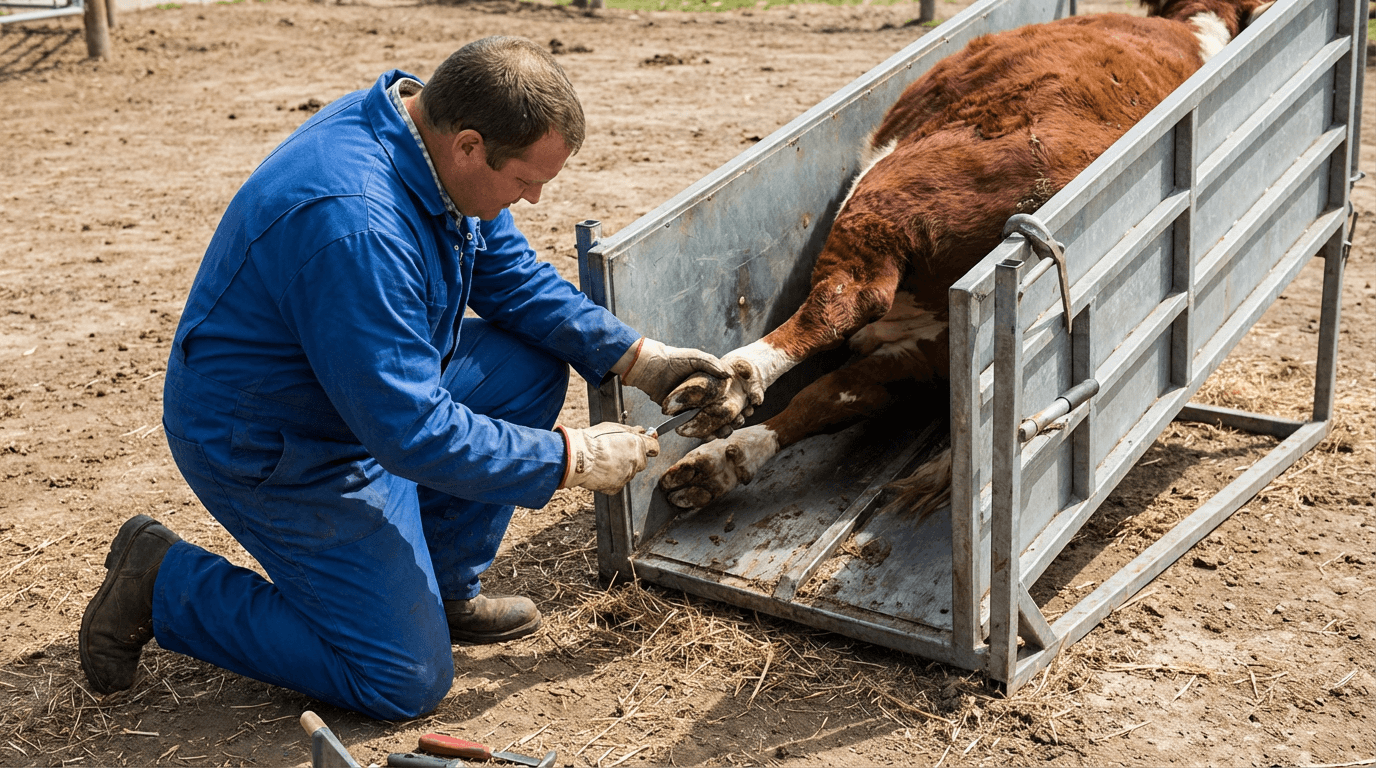
If you are comfortable handling cattle feet and can safely restrain the animal, examine the interdigital space. In classic foot rot you will find:
- A crack or ulceration in the interdigital skin — sometimes subtle in very early cases, obvious in established infections.
- Necrotic (dead, grey-white or yellowish) tissue with a characteristic foul odor described as sweet-rotten — distinctly different from normal barnyard smell.
- The interdigital skin may be eroded or have a punched-out appearance in more advanced cases.
- Exudate ranging from thin and watery in early infection to thick, purulent, and malodorous in advanced cases.
Advanced Signs: Days 4 Through 10 and Beyond
When foot rot is not treated or is caught late, the infection spreads from the soft interdigital tissue into deeper structures with progressively worsening consequences:
- Severe, non-weight-bearing lameness: The animal refuses to put any weight on the foot whatsoever.
- Pronounced swelling extending up the cannon bone — sometimes to the fetlock or higher.
- Fever: Rectal temperature above 104°F (40°C) indicates systemic involvement and demands immediate antibiotic therapy and veterinary consultation.
- Significant milk yield drop in dairy cows — often 20–40% reduction within 48 hours of symptom onset.
- Loss of body condition from pain-driven feed aversion over days to weeks.
Differential Diagnosis: Ruling Out Other Causes of Lameness
Several other conditions cause hoof or foot lameness in cattle, and treatment approaches differ substantially. Accurate diagnosis is essential before committing to a treatment plan.
| Condition | Key Distinguishing Features | Treatment Approach |
|---|---|---|
| Foot rot (Infectious Pododermatitis) | Symmetric swelling, interdigital necrosis, foul odor, acute sudden onset | Systemic antibiotics |
| Foot abscess (Solar abscess) | Asymmetric swelling, often no interdigital lesion, abscess drains at coronary band or sole | Hoof knife drainage, poultice |
| Digital dermatitis (Hairy heel warts) | Raised, strawberry-like lesion at heel, extremely painful to touch, less overall swelling | Topical antibiotics, oxytetracycline spray |
| Interdigital fibroma (corns) | Firm, non-painful tissue growth between claws, chronic lameness, no odor | Surgical removal if causing significant lameness |
| White line disease | Undermining of the white line, no interdigital involvement, gradual onset over weeks | Hoof trimming, block application to unload claw |
| Laminitis | Multiple feet affected simultaneously, herd-level problem, dietary or metabolic connection | Diet management, NSAIDs, reduce grain |
| Septic arthritis (joint infection) | Extreme lameness, joint distension, fever, does not improve with standard foot rot treatment in 72h | Emergency vet consultation, joint lavage |
When in doubt — especially when the animal is severely lame, has a high fever, or has been lame more than 5 days without improvement despite treatment — call your vet. Misdiagnosed foot rot that is actually septic arthritis or deep digital sepsis is a serious animal welfare concern and a major economic loss if surgical amputation becomes necessary due to delayed intervention.
Treatment Protocols: Antibiotics, Supportive Care, and What to Expect
The good news about straightforward foot rot is that it responds very well to systemic antibiotic therapy — provided treatment begins early. The pathogens involved are generally sensitive to a wide range of antibiotics commonly available to cattle producers in the United States, and a single course of the appropriate drug in an early case typically produces full resolution.
First-Line Antibiotic Options for Foot Rot
The following antibiotics are FDA-approved and have established label claims for bovine foot rot in the United States. Always follow label withdrawal times for meat and milk, and consult your herd veterinarian before initiating treatment to ensure compliance with your Veterinary-Client-Patient Relationship (VCPR) requirements in your state.
| Drug | Route | Typical Dose | Frequency | Meat Withdrawal | Milk Withdrawal | Notes |
|---|---|---|---|---|---|---|
| Oxytetracycline (LA-200) | IM or IV | 6.6–9.9 mg/lb (IM) | Every 48–72h (IM) | 22–28 days | 96h | First-line for many producers; cost-effective, widely available[1] |
| Penicillin G procaine | IM | 3,000–5,000 IU/lb | Every 24h x 3–5 days | 10 days | 48–72h | Inexpensive; requires daily handling of the animal[1] |
| Florfenicol (Nuflor) | SQ or IM | 40 mg/kg SQ (long-acting) | Once (SQ form) | 38 days (SQ) | Not labeled for dairy | Excellent tissue penetration; good for more advanced cases |
| Ceftiofur (Excenel, Excede, Naxcel) | IM or SQ | 1–2.2 mg/kg per product label | Per label (varies) | 0–13 days | 0h | Favorable dairy withdrawal; 3rd-generation cephalosporin |
| Tulathromycin (Draxxin) | SQ | 2.5 mg/kg | Once | 18 days | Not labeled for dairy | Single injection convenience; widely used in beef feedlots |
| Enrofloxacin (Baytril 100) | SQ | 7.5–12.5 mg/kg | Once daily x 3–5 days | 28 days | Not labeled for dairy | Reserved for refractory cases; use fluoroquinolones judiciously |
Treatment Response: A Timeline of What to Expect
Most uncomplicated cases of foot rot show significant improvement within 48–72 hours of initiating appropriate antibiotic therapy. Here is what to watch for at each checkpoint:
- 24 hours post-treatment: The animal may still be quite lame. This is normal — the antibiotic is working but inflammation takes time to resolve. If the animal's general attitude is better (eating more, less distressed), that is a positive sign.
- 48–72 hours post-treatment: Lameness should be noticeably improved. The animal should be bearing weight, eating better, and swelling should be reducing. If you see no improvement at 72 hours, reassess your diagnosis and consider veterinary involvement.
- 5–7 days: Most uncomplicated cases should be substantially resolved. Some residual swelling may persist for 10–14 days.
- No improvement after two full antibiotic courses: Call your vet. You may be dealing with a deeper infection, an antibiotic-resistant organism, or a misdiagnosis requiring a different treatment approach entirely.
Topical Treatment: Helpful Supplement, Not a Replacement
Systemic antibiotics are the cornerstone of foot rot treatment. Topical therapy is supplemental but can speed healing and reduce environmental contamination:
- Copper sulfate or zinc sulfate solution: Applied directly to the cleaned interdigital lesion, these reduce local bacterial load before bandaging.
- Iodine-based solutions: Betadine scrub applied to the cleaned wound area before wrapping provides additional antiseptic activity.
- Protective bandaging: In muddy environments, a clean bandage over the foot for 48–72 hours protects the healing tissue from recontamination. Change the bandage daily if conditions are very wet. Remove after 3–4 days maximum to prevent moisture accumulation under the bandage, which can worsen the situation.
Pain Management: An Overlooked Component
Foot rot is painful. Pain reduces feed intake, which reduces production and immunity, slowing recovery. Adding an NSAID to your treatment protocol is strongly recommended for moderate to severe cases:
- Flunixin meglumine (Banamine): 1.1–2.2 mg/kg IV or IM. Meat withdrawal 4 days, milk withdrawal 36 hours. The standard NSAID for bovine pain management in the US.
- Meloxicam: 0.5–1.0 mg/kg orally (off-label in US cattle — work with your vet). Longer-acting than flunixin; a good option where daily IV administration is not practical.
- Aspirin: For mild cases where cost is a primary concern, oral aspirin boluses provide cost-effective analgesia. Less potent than the options above.
Footbath Programs: Building a Prevention Protocol That Works
A well-managed footbath program is the most effective herd-level tool for preventing foot rot and digital dermatitis in cattle operations where housing, traffic, or wet conditions create ongoing challenge. But running cattle through some blue water and calling it a footbath program are very different things. The difference is in the details.
Footbath Design and Placement
The physical setup of your footbath determines how effective it can be, regardless of what chemical you put in it:
- Length: Minimum 10 feet (3 meters) for beef cattle; 12 feet preferred for larger-framed cattle. Each foot needs to take at least 2–3 full steps submerged in the solution. Shorter baths allow cattle to step through in a single stride, providing inadequate contact time.
- Width: 24–30 inches — narrow enough that cattle cannot step over it sideways, wide enough that they walk through normally without bunching or jumping.
- Depth: 4–6 inches of solution. Too shallow fails to wet the interdigital space adequately; too deep causes cattle to jump over or refuse to enter.
- Placement: Position the footbath where cattle must walk through it — immediately after the milking parlor exit in dairies, at forced-flow gate approaches in beef operations. Animals need no choice but to walk through.
- Pre-wash bath: A plain-water pre-wash bath positioned 3–4 feet before the chemical bath dramatically extends the useful life of your chemical solution by removing bulk manure and organic matter before cattle reach the active solution. In heavy traffic situations, this is not optional.
- Drainage access: The footbath must be easy to drain, clean, and refill. Footbaths that are difficult to service get neglected, negating their value entirely.
Zinc Sulfate: The Modern Standard
Zinc sulfate (ZnSO4) is the most widely recommended footbath chemical for cattle foot rot and digital dermatitis prevention.[3] Unlike copper sulfate — which is effective but presents significant environmental disposal concerns and is restricted or banned in some states — zinc sulfate is environmentally safer, equally effective against the key pathogens, and less corrosive to equipment and concrete surfaces.
| Parameter | Zinc Sulfate Recommendation |
|---|---|
| Concentration | 10% solution (approximately 1 lb ZnSO4 per gallon of water) |
| Solution change frequency (standard) | Every 200–300 cow passes, or when visibly contaminated with manure |
| Application frequency (prevention) | 2–4 times per week during high-risk periods |
| Application frequency (active outbreak protocol) | Daily for 5 consecutive days, then 2–3x per week for 2–3 weeks |
| Minimum contact time per foot | 2–3 full steps in solution (ensured by bath length) |
| Pre-wash bath change frequency | Every 100–150 cow passes |
| Approximate cost per bath change (10% ZnSO4) | $8–$20 depending on bath volume |
Copper Sulfate: Still Effective, With Important Caveats
Copper sulfate has a long track record in footbath programs and remains effective against the pathogens causing foot rot and digital dermatitis. Standard concentrations of 2–5% are used for prevention; 5–10% for active treatment protocols.[3] However, there are important considerations:
- Copper sulfate is classified as an aquatic pollutant. Spent footbath solution cannot legally be discharged to surface water or many groundwater systems in most states.
- Several states have explicit restrictions on copper sulfate footbath use or disposal. Check your state's environmental regulations before using it — particularly in the Pacific Northwest and parts of the Great Lakes region.
- Repeated disposal in the same location leads to copper accumulation in soil — a long-term concern for operations with environmental compliance requirements or organic certification.
- Copper sulfate is highly corrosive to galvanized metal equipment and concrete over time.
Given these concerns, most extension specialists and veterinary practitioners now recommend zinc sulfate as the default choice for cattle footbath programs, with copper sulfate reserved for situations where disposal and regulatory compliance can be properly managed.
The Most Common Footbath Program Failures
Even operations with footbaths in place often fail to get results. The most frequent problems:
- Solution too dilute: Producers dilute the chemical to save money. A 2% zinc sulfate bath provides a fraction of the protection of a 10% bath.[3] Do not compromise on concentration.
- Solution not changed frequently enough: A heavily contaminated footbath — visibly brown-green with manure — has essentially no antimicrobial efficacy. Worse, it may actively spread digital dermatitis organisms through contaminated solution touching every foot that passes through.
- Bath too short to be effective: Cattle step through in a single stride, each foot in the solution for less than a second. Extend the bath length.
- No pre-wash bath: Organic matter from manure neutralizes chemical activity within the first few cow passes. A pre-wash is essential in any meaningful traffic situation.
- Inconsistent use: Running cattle through the footbath once weekly during high-risk periods does a fraction of the good that three or four times per week provides. Consistency is the biggest driver of program effectiveness.
- Winter program lapse: Foot rot does not disappear in winter — it peaks in spring as mud season hits. Do not let your footbath program lapse between October and March for housed cattle.
Environmental Management: The Foundation That Footbaths Build On
Footbaths address the bacterial challenge; environmental management addresses the conditions that make cattle vulnerable to infection in the first place. The most effective foot rot prevention programs combine both. No footbath program can fully compensate for a chronically muddy, poorly managed feedlot or pasture system.
Drainage and Footing Quality
Wet, muddy conditions are the single greatest environmental risk factor for foot rot. Every dollar invested in drainage pays back many times over in reduced lameness incidence:
- High-traffic area surfacing: Barn alleys, feed bunk approaches, water trough surrounds, and gate areas are where cattle congregate and where mud is worst. Concrete, compacted gravel pads, or rubber mat surfacing in these specific areas dramatically reduces both foot trauma and prolonged moisture exposure.
- Proper alley slope: Concrete alleys should have a 1–2% slope for drainage without creating excessive slip risk. Barn gutters and drainage waterways should be functional and cleaned regularly.
- Gravel pads: A well-maintained gravel pad (4–6 inches of compacted 3/4-inch minus aggregate) at gates, water tanks, and feed areas provides drainage and significantly reduces mud. Budget for annual top-dressing.
- Pasture rotation: Rotating grazing pressure prevents overgrazing and breakdown of ground cover around water sources, avoiding permanent muddy sacrifice areas that serve as year-round foot rot reservoirs.
- Shade and congregation management: Cattle congregate in shade on hot days, creating heavily trafficked, often muddy areas beneath trees and shade structures. Position shade structures to facilitate drainage, or add gravel or wood chip surfacing beneath them.
Hoof Trimming Schedule
Regular hoof trimming is preventive medicine for foot rot. Overgrown hooves alter gait mechanics and stretch the interdigital skin, creating chronic micro-trauma that serves as a bacterial entry point over time. Establish a routine trimming schedule appropriate for your operation type:
| Operation Type | Recommended Trimming Frequency | Key Notes |
|---|---|---|
| High-production dairy cows | Twice yearly (dry-off and mid-lactation) | Monthly or more for problem animals |
| Dairy heifers | Before first calving; then on adult cow schedule | Critical transition period for establishing correct hoof shape |
| Beef breeding cows | Annually, ideally pre-breeding season | More frequent on rocky terrain |
| Breeding bulls | Annually minimum; pre-breeding season especially | Foot soundness is critical for breeding success — lame bulls do not cover cows effectively |
| Feedlot cattle | At receiving for problem animals; ongoing pen checks | Short-stay animals may not need trimming |
Nutritional Support for Hoof Health
Nutritional support for hoof integrity is frequently underappreciated in foot rot prevention programs. Key nutrients with direct evidence for reducing foot rot susceptibility:
- Zinc: Plays a central role in keratinocyte proliferation and skin barrier function. Zinc-deficient cattle show significantly higher foot rot rates in multiple research studies. Organic zinc sources (zinc methionine, zinc proteinate) have better bioavailability than inorganic zinc sulfate and are preferred for hoof health supplementation. Target 50–100 mg/head/day organic zinc in high-risk operations.
- Biotin: Supports white line integrity and sole horn quality. Most research evidence is from dairy cattle studies. Supplement at 20 mg/head/day; allow 3–4 months before evaluating response, as hoof horn growth is inherently slow.
- Copper: Required for cross-linking in connective tissue and hoof horn structure. Copper deficiency impairs both immune function and hoof quality. Monitor annual nutritional analysis; supplement to maintain 10–15 ppm dietary copper. Watch for copper-molybdenum antagonism in high-sulfur water or high-sulfur forages.
- Selenium and Vitamin E: Support local immune function at the foot level. Selenium-deficient cattle mount weaker immune responses to bacterial challenge. Ensure adequate selenium supplementation, particularly in selenium-deficient regions including much of the Pacific Northwest and Great Lakes areas.
Regional and Seasonal Considerations for US Producers
Foot rot risk is not uniform across the calendar year or across US geography. Understanding when and where your specific operation faces peak risk allows you to concentrate your preventive efforts strategically rather than spending the same resources year-round.
Seasonal Risk Patterns
| Season | Risk Level | Primary Risk Factors | Priority Actions |
|---|---|---|---|
| Spring (March–May) | Very High | Mud season, wet pastures, post-winter hoof overgrowth, calving traffic creating muddy areas | Intensive footbath program (3–4x/week), pre-breeding hoof trimming, drainage maintenance |
| Summer (June–August) | Low to Moderate | Dry conditions reduce risk broadly; irrigation areas and creek crossings remain risky | Maintain footbath 2x/week; monitor cattle in wet microzones |
| Fall (September–November) | Moderate to High | Return of rain, ground softening, post-summer hard footing created hairline cracks | Increase footbath to 3x/week; pre-winter hoof trimming |
| Winter (December–February) | Variable by region | Frozen ground creates trauma (outdoor); confined cattle in wet alleys (indoor) | Footbath program for confined cattle; monitor outdoor cattle for trauma-related cases |
Regional Profiles
- Northern Plains and Midwest: Freeze-thaw cycles create extremely rocky, traumatic footing in early spring, and late spring mud seasons are the dominant driver of herd outbreaks. A strong March through May intensive footbath program is the most important investment you can make in foot rot prevention in this region.
- Southeast and Gulf Coast: Year-round warm, wet conditions mean foot rot risk has no true low season. Footbath programs should run continuously with intensity adjusted upward during the wettest months — typically January through March and again in fall with tropical weather patterns.
- Pacific Northwest: Long, wet fall and winter seasons create extended high-risk periods from September through April. Combined with selenium deficiency in many regional soils, operations here often see higher background foot rot rates. Year-round footbath maintenance plus active selenium supplementation are both important.
- High Plains and Southwest: Summer irrigation and monsoon season bring temporary but intense mud risk. In very dry non-irrigated seasons, cracking of the interdigital skin from extreme dryness creates entry points for infection just as effectively as maceration from moisture — apply topical hoof conditioner or run cattle through a wet area periodically to prevent excessive drying and cracking.
- Appalachian and Mountain West: Rocky terrain year-round means traumatic skin breakdown is the dominant risk factor, rather than wet conditions. Careful evaluation of footing quality at stream crossings, on limestone rock outcrops, and in rocky pastures is critical. Gravel management and regular hoof trimming pay particular dividends here.
Complicated Foot Rot: Emergency Signs and When to Call Your Vet
The majority of foot rot cases in cattle can be handled effectively by a prepared producer using on-farm antibiotics and supportive care. But a significant subset of cases require veterinary intervention — and in these situations, the difference between calling the vet on day two and day seven can be the difference between full recovery and permanent lameness, digit amputation, or euthanasia.
Call Your Vet Immediately If You Observe Any of These
- No improvement after 72–96 hours of appropriate antibiotic therapy: Standard foot rot should be visibly improving by day 3. Failure to respond suggests a deeper infection, an antibiotic-resistant organism, or a misdiagnosis requiring a different treatment approach.
- Non-weight-bearing lameness (refusing to touch foot to ground): This strongly suggests involvement of deep structures — the coffin joint, deep digital flexor tendon sheath, or pedal bone. This is a veterinary emergency.
- Swelling extending above the fetlock joint: When swelling reaches the fetlock or higher, the infection has likely spread into tendon sheaths or higher anatomical structures that require specialized treatment.
- High fever above 105°F (40.5°C): Significant systemic involvement requiring IV antibiotic therapy and immediate veterinary assessment.
- Abscess erupting at the coronary band: Indicates infection has tracked under the hoof capsule and is escaping at the coronary band — a sign of deep tissue involvement.
- Bone visible or suspected to be exposed in the wound: Septic pedal osteitis (bone infection) requires aggressive surgical and medical management. Outcome is guarded without immediate expert intervention.
- Breeding bull within 30–60 days of turnout: A lame bull cannot cover cows effectively. Even a mild case that would be monitored for 24 hours in a cow is a same-day vet call in a bull approaching breeding season.
- High-value registered or breeding stock: Get your vet involved earlier rather than later for valuable animals. The economics of aggressive early intervention are far better than the cost of delayed treatment failure.
What Your Vet Can Do That You Cannot
| Condition | Veterinary Intervention Available | Expected Outcome |
|---|---|---|
| Deep digital sepsis (tendon sheath) | Tendon sheath lavage, regional limb perfusion with antibiotics, extended IV therapy | Guarded; 40–70% recovery with early intervention |
| Septic coffin joint | Joint lavage, intra-articular antibiotics, potential digit amputation | Guarded; euthanasia may be most humane if severe |
| Septic pedal osteitis (bone infection) | Surgical curettage, digit amputation in appropriate cases | Good if caught early; poor if chronic or extensive |
| Antibiotic-resistant infection | Culture and sensitivity testing, targeted antibiotic selection based on results | Often good with correct antibiotic; poor if treatment continues blindly |
| Digit amputation | Under sedation and regional anesthesia, removes one claw entirely | 80–90% return to function in beef cattle; more guarded in dairy cows |
| Regional limb perfusion | IV antibiotic infused into the distal limb vasculature via tourniquet — achieves tissue concentrations 10–100x higher than systemic therapy | Excellent for early-to-moderate deep infections; can salvage cases that systemic therapy cannot |
Building a Complete Herd Foot Health Program
Effective foot rot management is not about reacting efficiently to individual cases — it is about building systems that prevent cases, identify them early, and treat them efficiently when they do occur. The following framework gives you the structure to build that program on your operation.
The Four Pillars of Herd Foot Health
- Environment: Drainage improvement, footing quality, reduction of chronic mud exposure, surfacing of high-traffic areas. This is where the biggest prevention gains come from and where investment pays back most reliably. Budget at least as much for environmental improvements annually as you spend on antibiotic treatments.
- Footbath program: Properly designed bath, correctly dosed chemical, regularly changed solution, consistently used through high-risk periods. The footbath is your primary herd-level chemoprophylaxis tool — it supplements good environment; it does not replace it.
- Nutrition: Zinc (organic forms preferred), biotin, copper, and selenium at appropriate levels based on forage analysis and regional soil status. Annual nutritional analysis and targeted supplementation are investments with broad returns across herd health categories — not just foot health.
- Monitoring and early treatment: Train staff to identify lameness early using a consistent scoring system. Implement the 5-point locomotion scoring system (CMPSA scale or dairy equivalent) for regular herd evaluations. The difference in treatment success between catching a case on day 1–2 versus day 5–7 is dramatic and well documented.
Annual Foot Rot Management Calendar
| Month | Key Actions for Beef and Dairy Producers |
|---|---|
| January–February | Check confined cattle feet weekly; maintain footbath for housed cattle; review prior year lameness records to identify patterns |
| March | Begin intensive footbath program (3–4x/week) as mud season approaches; repair winter damage to concrete and gravel; order spring supplies |
| April–May | Peak vigilance; daily cattle observation for early lameness; spring hoof trimming before breeding season; inspect drainage after major rain events |
| June | Pre-breeding hoof trimming for bulls; reduce footbath to 2x/week if conditions dry; evaluate footing at waterers and shade areas |
| July–August | Monitor irrigated pastures and creek crossings; maintain footbath 2x/week; mid-year lameness record review |
| September | Increase footbath to 3x/week as fall rains begin; fall hoof trimming for dairy cows coming up to dry-off |
| October–November | Prepare winter housing facilities; check concrete and floor surfaces for wear; transition footbath program for confined cattle |
| December | Year-end lameness record review; evaluate prevention program effectiveness; plan next year improvements; order zinc sulfate supply for spring |
Record Keeping: Turning Data Into Decisions
You cannot manage what you do not measure. Track foot rot cases with at minimum: animal ID, estimated date of onset, date treatment started, drug used, response at 72 hours, final outcome, and whether veterinary involvement was required. Even a simple notebook or spreadsheet gives you the data to identify:
- Peak-risk seasons specific to your operation — which may differ from the regional average
- Chronic and repeat-case animals who are candidates for culling from the breeding herd
- Whether your footbath program timing is matched to your actual risk periods
- Return on investment from environmental improvements (reduced case rates post-improvement)
- Whether a particular pen, pasture, or housing area accounts for a disproportionate share of your cases
Frequently Asked Questions About Cattle Foot Rot
Can cattle get foot rot more than once in the same season?
Yes. Recovery from foot rot does not confer meaningful immunity against reinfection. An animal that recovers in April can develop a new infection in June if environmental conditions remain favorable. Animals that develop foot rot two or more times within a 12-month period are considered chronic cases. These animals typically have a predisposing factor — poor hoof conformation, nutritional deficiency, or unusually susceptible immune status — that makes them persistently vulnerable. Chronic repeat cases are strong culling candidates in most operation types.
Is foot rot contagious from cow to cow?
Foot rot is not highly contagious through direct animal-to-animal transmission. The causative bacteria are environmental — they live in soil, manure, and mud. Cattle in the same environment are exposed to the same bacterial challenge, which explains why multiple animals can develop foot rot around the same time without direct transmission being the driver. However, animals with active foot rot do shed more bacteria in their interdigital exudate, potentially increasing environmental bacterial loads in their immediate area. Isolating actively infected animals from the main herd can reduce environmental contamination, though this is not always logistically practical in large operations.
How long should I wait before deciding treatment has failed?
You should see meaningful improvement — the animal bearing more weight, reduced swelling, improved attitude and appetite — within 48–72 hours of starting appropriate systemic antibiotics. If there is no meaningful improvement by 72 hours, or any deterioration at any point, reassess your diagnosis and call your vet. Do not continue the same antibiotic for 5–7 days hoping for a late response when the animal showed no improvement in the first 72 hours. Waiting simply allows deeper infection to develop and worsens the prognosis dramatically.
What is the difference between foot rot and digital dermatitis?
These are distinct diseases that share some environmental risk factors and can coexist in the same herd and even the same foot. Foot rot is a deep tissue infection of the interdigital soft tissue, characterized by symmetric swelling above the hoof and necrosis between the claws — it requires systemic antibiotic therapy. Digital dermatitis (hairy heel warts) is a superficial skin infection of the heel and interdigital skin caused primarily by Treponema species. It presents as a raised, painful, strawberry-textured lesion with proliferative hair-like projections, without the deep symmetric swelling of foot rot. Digital dermatitis is highly contagious between cattle, spreads readily through contaminated footbath solutions, and is treated with topical oxytetracycline or lincomycin spray — not systemic antibiotics. Accurate diagnosis matters because the management approaches differ significantly.
Can I use a zinc sulfate footbath for pasture beef cattle?
Footbaths work best where cattle must pass through a specific point regularly. Pasture cattle without a reliable daily chokepoint are more difficult to run through footbaths consistently. Some producers install footbaths at pasture water tank approaches — this requires more frequent monitoring and solution changes (cattle often defecate in unfamiliar water sources), but it works well where water is a reliable congregation point. In operations where footbaths are not practical for pasture cattle, prevention focuses more heavily on environment, nutrition, regular hoof trimming, and rapid individual case identification and early treatment.
What zinc sulfate product should I use, and where do I get it?
Zinc sulfate monohydrate is the standard form used in footbaths. It is available from agricultural supply stores, farm co-ops, and livestock supply distributors. Buying in bulk (50-lb bags or drums) substantially reduces per-treatment cost. For a standard 10-foot by 30-inch bath filled to 5 inches depth — approximately 60 gallons — a 10% solution requires about 50 lbs of zinc sulfate. At bulk pricing of $0.50–$1.00/lb, that is $25–$50 per bath fill for the chemical alone. Compare this to the $200+ cost of a single treated foot rot case to appreciate the economics of prevention.
Should I vaccinate my cattle against foot rot?
There is currently no commercially available vaccine for foot rot in the United States that has demonstrated consistent efficacy in field trials. Research into foot rot vaccines has been ongoing for decades, and some autogenous vaccines (custom-made from organisms isolated from your specific herd) have been used in high-incidence operations — but these require veterinary involvement and have variable outcomes. The most effective prevention remains environmental management combined with a consistent footbath program and sound nutritional support.
Find a Large Animal Vet Near You
When foot rot progresses beyond what on-farm treatment can address — or when you want to build a formal herd health program with professional guidance on footbath protocols, nutrition programs, and hoof trimming schedules — you need a veterinarian experienced with cattle and livestock health management.
FarmVetGuide is the most comprehensive directory of large animal veterinarians in the United States, with listings for over 9,500 practices across all 50 states. Search by county to find cattle vets near you who offer mobile farm calls, herd health services, emergency care, and hoof trimming consultations. Filter by species treated, practice type, emergency availability, and USDA accreditation status to find the right fit for your operation and management style.
Build a relationship with a large animal vet before you face an emergency. A working VCPR (Veterinary-Client-Patient Relationship) means faster access to prescription medications, better guidance on antibiotic stewardship, and a professional who already knows your herd when complications arise.
Search the FarmVetGuide cattle vet directory to find experienced large animal veterinarians in your county today.
Sources & References
This guide references peer-reviewed research and guidelines from leading veterinary organizations. All medical information has been reviewed for accuracy against these authoritative sources.
- Merck Veterinary Manual — Lameness Originating in the Hoof in Cattle (Foot Rot / Interdigital Necrobacillosis). Last accessed March 2026.
- Penn State Extension — Lameness: It's Costing You (Economic Impact of Cattle Lameness). Last accessed March 2026.
- Oklahoma State University Extension — Foot Rot in Cattle: Cause, Prevention, and Treatment. Last accessed March 2026.
- Oklahoma State University Extension — Foot Rot Control in Cattle. Last accessed March 2026.
- Penn State Extension — Impacts of Lameness, Part 1: Preventing Lame Cows. Last accessed March 2026.
- University of Minnesota Extension — Foot Rot and Pink Eye in Cattle on the Rise. Last accessed March 2026.
- Merck Veterinary Manual — Penicillins: Use in Animals (Dosing and Indications). Last accessed March 2026.