Livestock Emergency Kit: What Every Farm Needs On Hand
By FarmVetGuide Editorial Team · Published December 2025 · Updated February 2026 · Based on verified data from our directory of 9,500+ practices
When a 1,200-pound cow develops a severe colic at midnight, or a newborn calf is born in a January snowstorm, the difference between life and death is often measured in minutes. Rural farms may be 30, 60, or even 90 minutes from the nearest large animal veterinary clinic. A well-stocked livestock emergency kit does not replace your veterinarian—nothing does—but it gives you the tools to stabilize an animal, provide critical first aid, and buy precious time until professional help arrives. This comprehensive guide covers every essential supply for a farm emergency kit, organized by category, with guidance on species variations, budget priorities, and how to use what you have.
Why Every Farm Needs a Livestock Emergency Kit
The Golden Hour in Livestock Medicine
Emergency medicine has long recognized the "golden hour"—the window immediately following a traumatic event during which treatment dramatically improves outcomes. The same principle applies to farm animals. A cow with hardware disease (traumatic reticuloperitonitis) treated within hours has a far better prognosis than one suffering for 24 hours. A kid with hypothermia warmed within an hour survives; one found cold for hours often cannot be saved. A foal with a fractured leg splinted promptly before transport can recover; an unsupported fracture worsens catastrophically with every step.
Having the right supplies on hand when these emergencies strike—and knowing how to use them—is one of the highest-return investments a livestock producer can make.
Understanding Your Role: First Aid, Not Veterinary Care
A farm emergency kit is for first aid and stabilization, not diagnosis and definitive treatment. Your job is to keep the animal alive, comfortable, and stable until your veterinarian arrives or you can transport the animal to a clinic. Many of the situations described in this guide—colic, dystocia, fractures, anaphylaxis—require professional veterinary care. Do not delay calling your vet while you attempt to treat. In many cases, the right action is: call the vet, then begin basic supportive care while waiting. Find emergency large animal veterinarians in your area at FarmVetGuide's emergency vet directory.
Category 1: Wound Care Supplies
Bandaging Materials
Lacerations, puncture wounds, and foot injuries are among the most common farm emergencies. A good wound kit includes:
- Vetrap (Cohesive Bandage): The workhorse of farm bandaging. Self-adherent, stretchy, and waterproof. Stock multiple rolls in 2-inch and 4-inch widths. Apply over primary wound contact layers—never directly on a wound.
- Gauze rolls (2-inch and 4-inch): Conforming gauze for building padding layers under Vetrap. Use multiple rolls for thick padding on limb wounds—"Robert Jones" style bandaging requires significant gauze bulk.
- Sterile wound pads (non-stick): Place directly against the wound to absorb exudate without adhering to the wound bed. Telfa pads, Melolin, or sterile non-adherent dressings. Stock at least 10–20 pads in multiple sizes.
- Elastic adhesive bandage (Elastikon): More durable than Vetrap for high-motion areas like knees and hocks. Expensive, so reserve for cases where Vetrap would slip.
- White medical tape: For securing bandage ends and labeling. Also useful for taping a thermometer to a post so you don't lose it.
- Cotton roll (sheet cotton, Combine rolls): Thick padding layer for limb bandages, especially for horses. 12-inch rolls.
Wound Cleaning Supplies
- Betadine Scrub (povidone-iodine scrub, 7.5%): Antiseptic cleanser for wound preparation. Dilute 1:10 with water for wound lavage (the color of weak tea). Full-strength scrub is too harsh for open wounds—use it only on intact skin around the wound. Stock at least two 32-oz bottles.
- Sterile saline flush: Saline is the gold standard for wound lavage—it is isotonic and non-damaging to healing tissue. Pre-packaged saline wound wash bottles (NeilMed, Blairex) are convenient. Alternatively, make a fresh batch: 1 tsp non-iodized table salt dissolved in 1 quart of clean boiled water. Use within 24 hours. A 35 mL syringe with an 18-gauge needle creates the high-pressure lavage (8–10 psi) needed to reduce bacterial counts in contaminated wounds.
- Hydrogen peroxide (3%): Limited use only—do NOT use routinely on open wounds. Hydrogen peroxide damages healing tissue and delays wound closure. Its only appropriate farm use is initial decontamination of heavily contaminated puncture wounds or embedded material. One application, then switch to saline lavage.
Wound Sprays and Topical Treatments
- Blue Kote (Gentian Violet): Antiseptic wound spray that provides a protective colored coating. The blue/purple color discourages fly strike and pecking by other animals. Useful for minor abrasions, scald wounds, and minor lacerations in cattle and small ruminants. Apply a thin coat after cleaning.
- Silver Sulfadiazine (SSD) Cream: Prescription antimicrobial cream for burns and serious wounds. Particularly valuable for wire wounds, rope burns, and skin loss injuries. Your vet can prescribe this for your farm kit.
- Corona ointment or Bag Balm: Lanolin-based moisturizing ointment for chapped teats, minor abrasions, and dry cracked hooves. Not a wound treatment per se, but useful for maintenance.
- Wound Kote powder (optional): Tetracycline-based wound powder useful for foot rot and some surface wounds in cattle and small ruminants. Dries the wound surface, but avoid overuse which can delay healing.
Suture Materials and Wound Closure
- Sterile gloves (exam and surgical): Essential for wound assessment and any procedure. Maintain a box of nitrile exam gloves in multiple sizes and at least 6 pairs of sterile surgical gloves for invasive procedures.
- Suture material: Having suture available does not mean you should be suturing wounds. Most farm wounds are better left open to heal by second intention (granulation). However, fresh (under 6 hours old), clean, deep lacerations on the trunk or upper limbs may benefit from closure. Your vet should do this. Stock 0 and 2-0 nylon or polypropylene for veterinary use if your vet has trained you. Suture practice on a cadaver or training model before attempting on a live animal.
- Skin stapler: Some vets prefer skin staples for closure; your vet may request this from your kit.
Tetanus Coverage
- Tetanus Antitoxin: Provides immediate passive immunity lasting 10–14 days. Use in unvaccinated animals with puncture wounds, deep lacerations, or at castration/disbudding in unvaccinated kids and lambs. Does NOT replace vaccination. Store refrigerated. Dose: 1,500 IU for small ruminants; 3,000–6,000 IU for horses and cattle (consult your vet).
- CDT Toxoid or Tetanus Toxoid: Active immunization—gives long-lasting protection (6–12 months) but takes 10–14 days to take effect. Part of routine herd vaccination, not emergency response alone.
Category 2: Medications (OTC vs. Prescription)
Many of the most valuable farm emergency medications require a valid Veterinarian-Client-Patient Relationship (VCPR) and a prescription. Establish this relationship with a veterinarian before an emergency—they are far more likely to prescribe a farm kit for a client they know and trust. The FDA's Veterinary Feed Directive and prescription requirements exist for good reason: misuse of antimicrobials contributes to resistance, and incorrect dosing of anti-inflammatories can cause kidney failure and gastrointestinal ulcers in livestock.
Banamine (Flunixin Meglumine) — Prescription Required
Flunixin meglumine is one of the most valuable emergency drugs a livestock producer can have. It is a potent NSAID (non-steroidal anti-inflammatory) that reduces fever, controls pain (especially visceral pain from colic and respiratory disease), and is the drug of choice for endotoxemia in cattle. It does not fix the underlying problem—a colicky horse given Banamine still needs emergency veterinary evaluation—but it buys critical time and keeps the animal from injuring itself or going into shock from pain.
- Cattle dose: 1.1–2.2 mg/kg IV (jugular) or oral granules/paste; repeat every 12–24 hours. Oral granules are available OTC in some states for cattle.
- Horse dose: 1.1 mg/kg IV or oral paste; repeat every 12 hours. NEVER give Banamine IM (intramuscularly) in horses—it causes severe muscle death (clostridial myositis) at the injection site, which can be fatal. IV or oral only.
- Small ruminants: 1.1 mg/kg IV or SQ; discuss dosing and off-label use with your vet.
- Storage: Room temperature, protected from light. Oral paste does not require refrigeration; injectable solution should be kept cool.
Penicillin G Procaine — OTC
Long-acting penicillin remains one of the most accessible antibiotics for livestock. It covers gram-positive bacteria well and is commonly used for foot rot (Fusobacterium), respiratory infections, and wound infections. Available over-the-counter at most farm supply stores.
- Cattle dose: 3,000–6,000 IU/lb (6,600–13,200 IU/kg) SQ every 24 hours. Beef withdrawal: 10 days; dairy withdrawal: 4 days.
- Goat/sheep dose: Off-label; discuss with your vet. Often 3,000–6,000 IU/lb SQ every 24 hours.
- Storage: Refrigerate; do not freeze. Shake well before use. Discard if color or consistency changes.
LA-200 / Biomycin (Oxytetracycline) — OTC
Long-acting oxytetracycline (200 mg/mL) is a broad-spectrum antibiotic used for respiratory disease (BRD), pinkeye, foot rot, and other bacterial infections in cattle and small ruminants.
- Cattle dose: 9 mg/lb (20 mg/kg) SQ or IM once every 48–72 hours for beef; check label. Beef withdrawal 28 days; dairy: not approved for lactating dairy cattle.
- Precaution: IM injection of LA-200 causes severe tissue damage—minimize volume per injection site (10 mL maximum per site), rotate sites, and inject SQ when possible. Always give SQ in small ruminants.
Epinephrine 1:1000 — Prescription in Most States
Epinephrine is the first-line emergency treatment for anaphylaxis—a severe allergic reaction that can occur within minutes of vaccine or drug administration. Signs: sudden agitation, trembling, difficulty breathing, facial swelling, collapse. Epinephrine reverses bronchospasm and vasodilation, potentially saving an animal's life before your vet arrives.
- Dose: 0.5–1 mL per 100 lbs SQ or IM for cattle and horses; 0.5–1 mL SQ for small ruminants. Consult your vet for species-specific guidance before an emergency.
- Storage: Refrigerate; protect from light. Replace annually—it degrades. Keep near vaccination supplies.
Dexamethasone — Prescription Required
A corticosteroid with potent anti-inflammatory effects. Used for shock, allergic reactions (in conjunction with epinephrine), and inflammatory conditions. Never use in pregnant cattle or mares in late pregnancy—dexamethasone can induce premature parturition. Use under veterinary guidance.
Vitamin B Complex — OTC
B-vitamins (especially thiamine) are essential for rumen function and neurological health. Polioencephalomalacia (thiamine deficiency, often called "goat polio") causes neurological signs including blindness, incoordination, and seizures in sheep and goats. High-dose thiamine given early is life-saving. Vitamin B complex injectable is safe, inexpensive, and worth having for any ruminant emergency. Dose: 1 mL per 10 lbs SQ or IM, repeated every 6 hours for polio; for general support, 10–20 mL IM in cattle.
Selenium/Vitamin E Injectable (BoSe) — Prescription Required
Essential in selenium-deficient regions. Used to treat and prevent White Muscle Disease in calves, lambs, and kids. Selenium has a narrow therapeutic index—the dose that prevents deficiency is close to the toxic dose. Never use without veterinary guidance on appropriate dosing for your region and species.
Oral Electrolytes
Dehydration from scours (diarrhea) kills more baby livestock than almost any other condition. Oral electrolyte solutions (Bounce Back, Re-Sorb, Calf-Lyte, Dura-Lyte) replace fluids, electrolytes, and provide glucose energy. Keep multiple packets on hand for all species you raise. Mix according to directions—do not use sports drinks or homemade solutions as first-line treatment, as sodium content must be carefully balanced.
- When to use oral vs. IV: Oral electrolytes work for calves/kids that still have a suckle reflex and can stand. Animals that cannot stand, have a weak or absent suckle, are severely sunken-eyed, or have been scouring for more than 24 hours need IV fluids—call your vet immediately.
Category 3: Reproductive Emergency Supplies
Difficult births (dystocia) are among the most time-critical livestock emergencies. Every minute of delay after the onset of active labor with no progress worsens outcomes for both dam and offspring. See also our guide on when to call the vet for cattle emergencies.
OB Lubricant
J-Lube (powder concentrate, mix with water) or pre-mixed OB lubricant (Vet-Lube) is absolutely essential for any assisted delivery. Never attempt to assist a birth without generous lubrication—you risk tearing the birth canal, breaking the calf/kid's legs, and causing permanent damage to the dam. For a difficult cattle delivery, you may need an entire batch of J-Lube (1 oz powder dissolved in 1–2 quarts of water). Keep at least 2 jars of J-Lube powder plus a gallon jug of pre-mixed lubricant.
OB Chains and Handles
Obstetrical chains (30-inch medium-link steel) are used for traction on calves in difficult deliveries. Loop the chain around the leg above the fetlock (ankle) to avoid breaking the leg. OB handles allow controlled, even traction. Keep 2–3 chains and 2 handles. Equine OB chains are longer and heavier; bovine and small ruminant chains are more lightweight. Kid snares (thin nylon or wire loops) are used for small ruminant deliveries—standard OB chains are too large and heavy for goats and sheep.
Calf Puller
A mechanical calf puller (Swanson-type) provides far more controlled traction than manual pulling and greatly reduces the risk of injury to the dam. Critical for any cattle operation that calves without consistent vet access. Learn how to use it properly before calving season—the device must be used correctly or it can cause more harm than good. Most extension offices and large animal vets offer short training sessions.
Stomach Tube and Pump
A flexible stomach tube (esophageal feeder) with a squeeze-bulb or pump is invaluable for delivering colostrum to weak newborns who cannot suckle, for treating bloat in ruminants, and for administering oral medications to animals that won't accept a bottle or drench. Stock one calf-sized (3/4-inch diameter, 5-foot long) and one lamb/kid-sized (1/4-inch diameter). Passing a stomach tube incorrectly into the trachea is life-threatening—feel for the tube in the esophagus (left side of the neck) before pumping anything.
Milk Replacer and Colostrum Supplies
- Colostrum replacer (not supplement): Know the difference—colostrum replacers contain enough IgG (immunoglobulin) to provide passive protection on their own; colostrum supplements do not. Use replacer when no maternal colostrum is available. Match species: bovine colostrum replacer for calves, ovine/caprine for lambs and kids. Bovine colostrum provides some passive protection to lambs and kids in an emergency but is not ideal.
- Milk replacer: Quality species-appropriate milk replacer for raising orphan or pulled animals. Do not use calf milk replacer for lambs or kids long-term—protein and fat ratios differ significantly.
- Nursing bottles and nipples: Multiple sizes—large calf nipples, smaller lamb/kid nipples. Have extras. Nipples wear out and crack.
- Lamb/kid warming box: A cardboard box with a low-wattage light bulb or heating pad covered with towels. Inexpensive and life-saving in cold weather.
Other Reproductive Supplies
- Fleet enema: For meconium (first stool) constipation in newborns. Goat and sheep kids and calves that have not passed their first stool within a few hours may need gentle stimulation. Use the pediatric size—do not use adult enemas.
- Long OB gloves: Shoulder-length disposable OB gloves for internal examination during dystocia. Keep at least 2 boxes.
- Tail wrap: Vetrap or bandage wrap to secure the tail out of the way during examination or delivery.
Category 4: Instruments and Tools
Thermometers
A rectal thermometer is the single most important diagnostic tool you own. Temperature tells you whether an animal has a fever (infection, inflammation), is hypothermic (cold stress, shock), or is normal. Normal ranges: cattle 101–102.5°F; horses 99–101°F; goats and sheep 101.5–104°F; pigs 101–103°F. Digital rectal thermometers read in 10–30 seconds. Buy three: one always has a dead battery. Attach a string and alligator clip to avoid losing it rectally—it happens.
Stethoscope
A basic stethoscope allows you to assess gut sounds in ruminants (critical for diagnosing bloat, hardware disease, and displacement of the abomasum), heart rate, lung sounds, and blood pressure (roughly). You do not need an expensive cardiology-grade scope—a standard Littmann Classic II SE or similar model works well for farm use. Learn the "four quadrant" gut sound evaluation for cattle: left paralumbar fossa (rumen), left flank high (gas cap), right flank high (ping check), right ventral (abomasum). Absence of gut sounds in a ruminant is always significant.
Flashlight and Headlamp
Emergencies happen at night. A hands-free headlamp is more valuable than a flashlight when you need both hands for an assisted delivery or wound treatment. Keep a dedicated headlamp in the emergency kit with fresh batteries. A headlamp with a red light mode preserves night vision. A powerful flashlight provides better illumination for wound assessment.
Cutting Tools
- Sharp fixed-blade knife: For cutting entangled baling twine, opening placental membranes, creating drainage in abscesses (veterinary guidance needed), and general farm use. A quality stainless-steel blade that can be cleaned and sharpened.
- Bandage scissors (blunt-tipped): For removing bandages safely without cutting skin.
- Hoof pick: For removing debris from hooves before examining for foot rot or laminitis.
- Wire cutters: For freeing animals entangled in fencing—a genuine life-threatening emergency in cattle and horses.
Restraint Equipment
- Halters in multiple sizes: Cattle, horse, and calf sizes. A restrained animal is a safer animal to treat. Keep at least one rope halter (doesn't break as easily as nylon hardware halters under severe stress) and one adjustable nylon halter.
- Lead ropes: At least 3 in various lengths. A quick-release snap is safer than a fixed snap—allows you to release an entangled animal quickly.
- Cattle nose tongs (Baxter tongs): For temporary restraint during procedures in cattle. Use briefly—prolonged use causes tissue damage.
- Kick bar or anti-kick device: For working safely around dairy cows that kick during milking or treatment.
Syringes and Needles
Stock a variety of syringe sizes and needle gauges for different medications and injection sites:
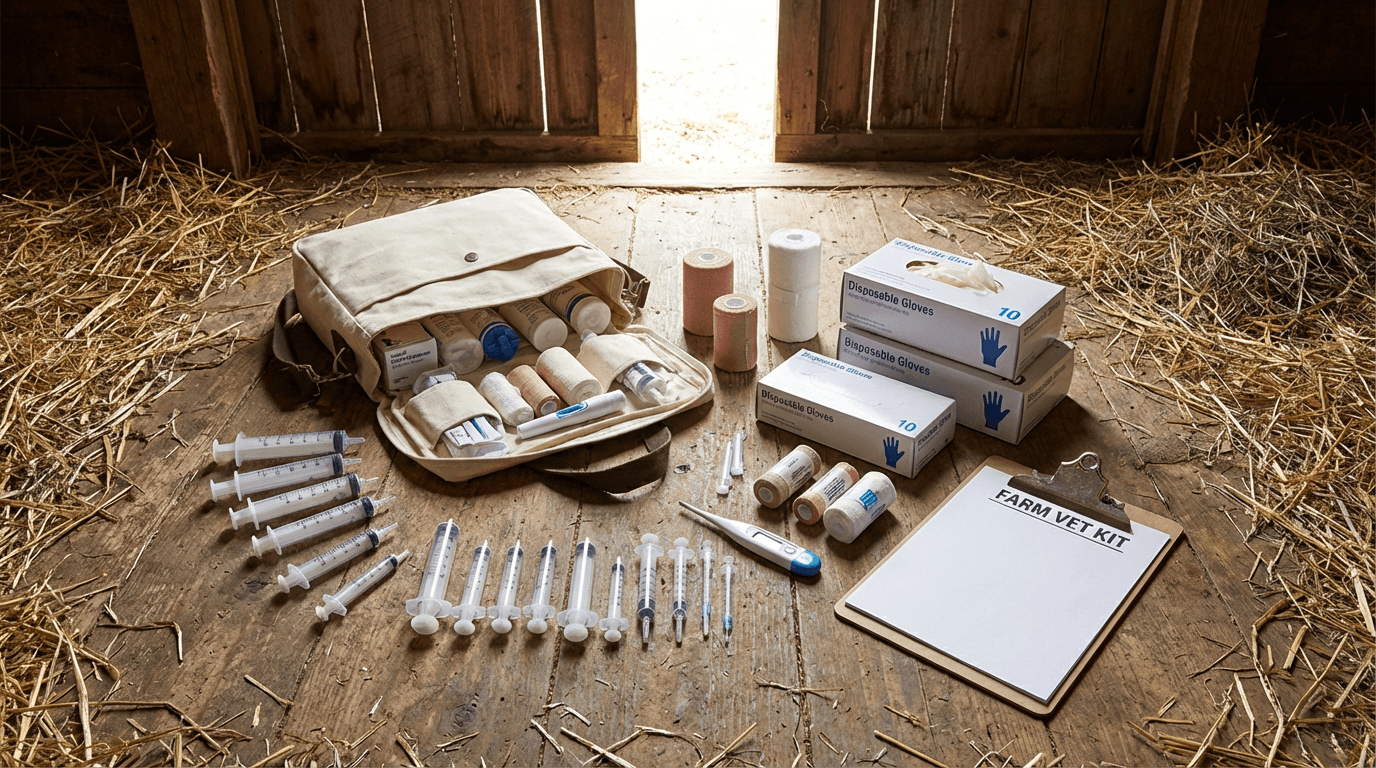
- Syringes: 3 mL, 6 mL, 12 mL, 20 mL, and 35 mL. The 35 mL is invaluable for wound lavage (attach an 18-gauge needle for high-pressure irrigation).
- Needles: 18-gauge x 1.5 inch (SQ injections in adult cattle, general use), 18-gauge x 1 inch (SQ in small ruminants), 16-gauge x 1.5 inch (IM in cattle), 20-gauge x 1 inch (SQ in calves, kids, lambs). Stock at least 20 needles of each size. Never reuse needles—tip damage causes unnecessary tissue trauma and infection risk.
- Sharps container: A rigid puncture-resistant container for safe needle disposal. Farm supply stores sell agricultural sharps containers; many areas have disposal programs.
IV Catheter and Fluid Supplies
Intravenous fluid administration can be life-saving for severely dehydrated calves, animals in shock, and horses in severe colic. This is an advanced skill requiring veterinary training—do not attempt without proper instruction. However, having the supplies means your vet can immediately begin treatment on arrival without delay.
- IV catheters: 14-gauge x 5.5 inch for jugular catheterization in calves; 12-gauge for adult cattle and horses. Self-adhesive bandage and tape to secure the catheter.
- IV fluid bags: 1-liter bags of 0.9% NaCl (normal saline) and Lactated Ringer's Solution. Administer only under veterinary supervision or with veterinary training.
- IV administration set: Drip tubing appropriate for large animal use. Large animal drip sets have a larger bore tubing than human pediatric sets.
Drenching Gun
For administering oral medications, electrolytes, and nutritional supplements (propylene glycol, probiotics, calcium gels) to animals that won't voluntarily consume them. Dose-specific drenching guns (set to a specific volume per squeeze) reduce dosing errors. Have one sized for cattle and one for small ruminants.
Category 5: Reference Materials
Supplies alone are not enough—you need to know when and how to use them. Include the following in your emergency kit binder or posted prominently in the barn:
Emergency Veterinary Contact Information
Post the following in multiple locations (barn, house, truck, phone notes):
- Your primary large animal veterinarian's direct number and after-hours emergency line
- The nearest 24-hour equine emergency clinic (if you have horses)
- A backup veterinarian for when your primary is unavailable
- The ASPCA Animal Poison Control Center: (888) 426-4435 (fee applies)
- FarmVetGuide Emergency Vet Finder for locating on-call vets in your area
Dosing Charts
Create laminated dosing charts for each species and weight range on your farm. Include: medication name, dose (mg/kg and practical mL/100-lb calculation), route of administration, frequency, withdrawal time, and storage requirements. Review and update charts annually with your veterinarian. Calculating doses under stress leads to errors—a pre-calculated chart prevents this.
Poison Plant Guide
Know the toxic plants in your region. Common dangerous plants include bracken fern (cattle, horses), black walnut (horses), rhododendron (goats, sheep), water hemlock (all species), oleander (all species), and yew (all species). The USDA Natural Resources Conservation Service plants database and your local extension service publish region-specific toxic plant guides. A laminated reference card in the barn saves critical time if you find an animal that has consumed unknown plant material.
Species Normal Vital Signs Reference
Post a laminated card with normal vital signs for each species on your farm:
| Species | Temperature (°F) | Heart Rate (bpm) | Respiratory Rate (rpm) |
|---|---|---|---|
| Adult Cattle | 101.0–102.5 | 48–84 | 26–50 |
| Calves | 101.5–104.0 | 100–120 | 30–60 |
| Horses | 99.0–101.0 | 28–44 | 10–24 |
| Goats | 101.5–104.0 | 70–135 | 15–30 |
| Sheep | 101.5–104.0 | 70–90 | 16–34 |
| Pigs | 101.0–103.0 | 58–100 | 20–40 |
Storage, Rotation, and Expiration Management
A kit with expired medications is worse than no kit—it gives false confidence. Build a medication management system:
- Central storage location: A weatherproof, lockable cabinet in a temperature-controlled area of the barn. Medications that require refrigeration (epinephrine, vaccines, some antibiotics) need a dedicated mini-fridge, not the household refrigerator where children might access them.
- Expiration date log: Maintain a simple spreadsheet or paper log of each item, quantity, and expiration date. Review quarterly. Mark items expiring within 90 days for priority use or replacement.
- First-in, first-out rotation: New supplies go behind existing supplies. Use oldest stock first to minimize waste.
- Vehicle kit: Maintain a smaller "immediate response" kit in your truck or ATV for use in the field—thermometer, flashlight, Vetrap, gloves, a few syringes, and your vet's number. The full kit stays in the barn.
- After any emergency: Immediately restock used supplies before the next emergency strikes.
Species-Specific Kit Variations
Cattle Emergency Kit Additions
Cattle-specific needs beyond the base kit include: magnet (for hardware disease prevention in beef cattle—not all vets support routine magnets, but they remain widely used), prolapse retainer (for uterine prolapse post-calving, to keep tissue moist until the vet arrives), bloat trocar (for severe bloat when death is imminent and the vet cannot arrive in time—use only when the vet advises and authorizes), milk of magnesia or ruminotoric drenches (for simple bloat), and Oxytocin (prescription—for stimulating uterine contractions or milk let-down, under veterinary direction only). Find cattle veterinarians near you at FarmVetGuide's cattle vet directory.
Equine Emergency Kit Additions
Horses require: standing wraps and polo wraps (for limb support during transport), hoof boot (for protecting a damaged or bare hoof during transport), digital pulse palpation experience (for laminitis assessment), a dose of Banamine paste in the barn AND in the trailer for colic, and a detailed colic protocol discussed with your vet in advance (many vets want to be called before Banamine is given, to ensure appropriate triage). Equine emergencies can escalate rapidly—find an emergency equine vet near you now, before you need one.
Small Ruminant (Goat and Sheep) Kit Additions
Goats and sheep need: FAMACHA cards and training for parasite assessment, Thiamine B1 injectable (for goat polio—a true emergency), copper boluses (goats, not sheep), Baking soda free-choice (rumen buffer for acidosis), drench gun in small ruminant size, and a warming box for hypothermic kids and lambs. Find goat veterinarians at FarmVetGuide and sheep veterinarians at FarmVetGuide's sheep vet finder.
Building Your Kit on a Budget
Priority Purchases: $100 Budget
If you can only spend $100, focus on the supplies that address the most common, immediately life-threatening situations:
- Digital thermometer(s) — $15
- Vetrap (12-pack assorted) — $20
- Sterile wound pads and gauze — $15
- Betadine scrub (32 oz) — $15
- Assorted syringes and needles — $15
- Nitrile exam gloves (box) — $10
- Headlamp — $10
Comprehensive Kit: $500 Budget
With $500, you can build a solid comprehensive kit covering most emergencies:
- All items from $100 kit — $100
- OB lubricant (J-Lube + premixed) — $30
- OB chains and handles — $40
- Stomach tube (calf and kid sizes) — $30
- Oral electrolytes (12-pack) — $30
- Long OB gloves (2 boxes) — $25
- Stethoscope — $50
- Penicillin G and oxytetracycline — $40
- Vitamin B complex injectable — $20
- Tetanus antitoxin (2 bottles) — $30
- Blue Kote and wound spray — $20
- Colostrum replacer — $40
- Reference binder with dosing charts — $15
- Lockable storage cabinet — $30
The Conversation with Your Veterinarian
The most important step in building a farm emergency kit is a sit-down (or phone call) conversation with your veterinarian before an emergency occurs. This conversation should cover:
- What prescription medications they are comfortable prescribing for your farm kit (Banamine, epinephrine, BoSe, dexamethasone)
- Specific dosing protocols for your animals' weights and species
- Which situations they want you to call first vs. treat first
- Their emergency protocol and after-hours contact procedure
- Whether they offer farm-call training sessions (many vets will train trusted clients to perform basic procedures)
A vet who knows your operation is far more likely to prescribe a robust farm kit, trust your assessment over the phone, and respond quickly when you call. Use the FarmVetGuide emergency preparedness checklist to document your protocols and share them with your vet.
Training Farm Staff
Supplies and knowledge are useless if only one person on the farm knows where the kit is and how to use it. Build a team approach to emergency preparedness:
- Post protocols in the barn: Laminated quick-reference guides for the most common emergencies (bloat, colic, hypothermic newborn, anaphylaxis), including when to call the vet and who to call.
- Designate who can give injections: Every employee who works with livestock should know how to take a temperature and call the vet. Only trained staff should administer injections or perform any invasive procedure.
- Annual review: Go through the kit every spring. Update expiration dates, replace used or expired items, review protocols, and confirm the vet contact list is current.
- Mock drills: Talk through common scenarios with staff. "The vet can't be here for 45 minutes and we have a calf with scours—what do we do?" Thinking through scenarios in advance prevents panicked, wrong decisions in the moment.
Complete Livestock Emergency Kit Checklist
| Item | Quantity | Approx. Cost | OTC or Rx |
|---|---|---|---|
| Digital rectal thermometer | 3 | $15 | OTC |
| Stethoscope | 1 | $50 | OTC |
| Headlamp with batteries | 1 | $25 | OTC |
| Vetrap (assorted widths) | 12+ rolls | $20 | OTC |
| Sterile wound pads | 20+ | $15 | OTC |
| Gauze rolls (2" and 4") | 12+ | $12 | OTC |
| Betadine Scrub (32 oz) | 2 | $25 | OTC |
| Saline wound wash (16 oz) | 3 | $18 | OTC |
| Nitrile exam gloves (box) | 2 boxes | $20 | OTC |
| Long OB gloves | 2 boxes (50 ct) | $25 | OTC |
| OB lubricant (J-Lube + premixed) | 2 jars + 1 gal | $30 | OTC |
| OB chains + handles | 3 chains, 2 handles | $40 | OTC |
| Calf puller | 1 | $80 | OTC |
| Stomach tube (calf size) | 1 | $20 | OTC |
| Stomach tube (kid/lamb size) | 1 | $15 | OTC |
| Syringes (3, 12, 35 mL) | 10 each | $20 | OTC |
| Needles (18g, 20g, 16g) | 20 each | $15 | OTC |
| Sharps container | 1 | $12 | OTC |
| Oral electrolytes (calf/multi-species) | 12 packets | $30 | OTC |
| Penicillin G procaine | 100 mL | $15 | OTC |
| Oxytetracycline LA-200 | 100 mL | $20 | OTC |
| Vitamin B complex injectable | 100 mL | $15 | OTC |
| Tetanus antitoxin | 2 bottles | $25 | OTC/Rx varies |
| Banamine (flunixin meglumine) | 100 mL | $30 | Rx required |
| Epinephrine 1:1000 | 30 mL | $15 | Rx required |
| Selenium/Vit E (BoSe) | 50 mL | $25 | Rx required |
| Blue Kote wound spray | 2 | $18 | OTC |
| Colostrum replacer | 2 bags | $40 | OTC |
| Milk replacer | 1 bag | $30 | OTC |
| Nursing bottles + nipples | 6 | $20 | OTC |
| Fleet enema (pediatric) | 6 | $12 | OTC |
| Wire cutters | 1 | $20 | OTC |
| Bandage scissors | 2 | $15 | OTC |
| Halter (cattle and horse) | 2 each | $30 | OTC |
| Lead ropes | 3 | $20 | OTC |
| Drenching gun (cattle + small ruminant) | 2 | $25 | OTC |
| Reference binder (laminated dosing charts, emergency contacts) | 1 | $15 | OTC |
| Lockable cabinet with mini-fridge | 1 each | $100 | OTC |
Frequently Asked Questions: Livestock Emergency Kits
Can I legally give my livestock Banamine without a vet prescription?
In the United States, flunixin meglumine (Banamine) injectable is a prescription drug—you legally require a valid VCPR and a prescription from your veterinarian to purchase and administer it. However, Banamine oral granules and paste are available over-the-counter at farm supply stores for cattle in many states (though not all). Regulations vary by state. The safest approach: establish a VCPR with a local large animal vet who can prescribe Banamine for your farm kit after a herd visit. This is far safer—both legally and medically—than purchasing injectable Banamine through gray-market channels. Your vet will also ensure you know the correct dose and route for your species.
How often should I rotate and replace emergency kit supplies?
Conduct a full inventory audit twice yearly (spring and fall). Check expiration dates on every medication, vaccine, and biological product. Injectable medications that have been opened and exposed to air should be replaced more frequently than manufacturer expiration dates suggest—most multi-dose vials should be discarded within 30 days of first use. Wound care supplies (non-expired, sealed packs) can last years. Bandaging materials should be replaced if they have been exposed to moisture, extreme heat, or have been partially used. After any emergency where supplies were used, restock immediately—do not wait for the next audit.
What is the single most important item in a livestock emergency kit?
If forced to choose one item, most large animal veterinarians would say: a thermometer. An accurate temperature reading is the fastest way to determine whether an animal has a fever (likely infection or inflammation), is hypothermic (requires immediate warming and glucose support), or is normal (reassuring). Temperature guides every decision—whether to call the vet urgently, which medications to reach for first, and whether a treatment is working. A $10 digital thermometer is the highest-ROI tool in your entire kit. The second most important item is your veterinarian's phone number.
Can I use human medical supplies for livestock emergencies?
Many wound care supplies are interchangeable—sterile gauze, non-adherent wound pads, bandage scissors, and saline wound wash are identical products whether sold at a pharmacy or a farm supply store. The key differences are scale (livestock need far more bandaging material than a human wound) and some product formulations (do not use human antibiotic ointments like Neosporin as a primary treatment on livestock—they are not toxic, but are not efficacious for the bacterial profiles common in livestock wounds). Human oral rehydration solutions are NOT appropriate substitutes for livestock electrolytes—sodium concentrations differ significantly. Never use human medications (Tylenol, Advil, Benadryl) in livestock without explicit veterinary guidance.
What should I do first when I find a sick or injured animal—call the vet or start treatment?
Call the vet first. This cannot be overstated. While you are on the phone describing the situation, the veterinarian can guide you on immediate actions. Many producers delay calling, attempt home treatment, and then call the vet hours later when the animal is in worse condition. Early veterinary guidance consistently improves outcomes, even if the vet cannot arrive quickly. Take the animal's temperature, observe the clinical signs (what does the breathing look like? any discharge? posture? gum color?), and have this information ready when you call. See our full guide on when to call the vet for a cattle emergency. To find a veterinarian available for farm calls in your area, use FarmVetGuide's emergency vet directory.
Find a Vet by Species or Service