Goat Kidding Problems: When to Call the Vet
By FarmVetGuide Editorial Team · Published January 2026 · Updated February 2026 · Based on verified data from our directory of 9,500+ practices
Every goat farmer, whether managing a small backyard herd or a commercial dairy operation, will eventually face a difficult kidding. The hours surrounding birth are the most critical in a kid's life—and some of the most stressful for producers. Knowing when to wait, when to intervene, and how to handle complications can mean the difference between a healthy kid on the ground and a lost animal. This comprehensive guide walks you through everything from pre-breeding management to newborn care, giving you the confidence and knowledge to handle goat kidding problems when they arise.
Understanding the Goat Breeding Season
The Doe's Reproductive Cycle
Most domestic goat breeds are seasonally polyestrous, cycling from late summer through early winter as day length shortens. A doe's estrous cycle averages 18–21 days, with estrus (standing heat) lasting 12–36 hours. Ovulation occurs 12–36 hours after the onset of standing heat. Nigerian Dwarf and Pygmy goats are the notable exceptions—they cycle year-round, making them particularly valuable for continuous milk production.
Signs of estrus include tail flagging (rapid side-to-side wagging), vocalizing, decreased milk production in lactating does, swollen vulva, and clear to slightly cloudy vaginal discharge. Does in heat will often ride or be ridden by herd-mates. Keeping a buck or buck rag nearby dramatically improves your ability to detect heat.
Ideal Breeding Timing
For Nigerian Dwarfs and standard dairy breeds, most producers target breeding in October–November for March–April kids, aligning with warming weather and spring grass. Meat breed producers (Boer, Kiko) often aim for fall kids to target spring feeder markets. The gestation length in goats is approximately 150 days (145–155 range), making calendar planning straightforward.
Introducing a buck 4–6 weeks before the intended breeding season triggers a "buck effect," stimulating does to cycle more synchronously. This is especially valuable if you want a compressed kidding window rather than kids spread over weeks.
Buck Management
Bucks require separate housing from does except during breeding. Keep bucks in good body condition (BCS 3–3.5 on a 5-point scale) year-round, increasing nutrition 6–8 weeks before breeding. A thin buck has poor libido and reduced semen quality. Check buck soundness before each breeding season: examine feet, legs, scrotal circumference (minimum 25 cm for mature bucks), and perform a basic breeding soundness evaluation if production matters. Rotate bucks with multiple does to prevent overuse—one buck can typically service 25–30 does per season.
Pre-Kidding Preparation: Setting Your Does Up for Success
Nutritional Management: Flushing and Steaming Up
Flushing refers to increasing the energy level of does 2–3 weeks before breeding. A higher plane of nutrition stimulates ovulation and increases the likelihood of multiple ovulations (twins, triplets). Flush with 0.5–1 lb of grain per day above maintenance, or by moving does to better pasture. The goal is an upward nutritional trend, not obesity—target BCS 2.5–3.5 at breeding.
Steaming up is the gradual increase in grain during the last 4–6 weeks of pregnancy. This critical period coincides with the final rapid growth of the kids, when 70% of fetal growth occurs. Gradually increase grain from 0.5 lb/day to 1–1.5 lb/day by kidding time, depending on litter size and doe size. Abrupt dietary changes cause rumen upset—always transition slowly over 7–10 days. Provide free-choice quality grass hay throughout pregnancy; alfalfa can be incorporated but watch for excess calcium disrupting calcium homeostasis pre-freshening.
Deworming Protocols: FAMACHA and Strategic Deworming
Barber pole worm (Haemonchus contortus) is the number one parasite killer of goats in the southeastern and mid-Atlantic US. The periparturient rise—a surge in worm egg shedding around kidding—makes late pregnancy a critical time for parasite management. However, blanket deworming all animals contributes to anthelmintic resistance, which is widespread and severe in goat parasites.
The FAMACHA system scores the color of the conjunctiva (inner eyelid) on a 1–5 scale, with 5 being severely anemic. Only deworm animals scoring 3, 4, or 5. Combine FAMACHA with FIVE-point check scores (BCS, dag score, bottle jaw, coat, FAMACHA) to identify animals truly in need. Deworm strategic groups: does in the last 2 weeks of pregnancy and at kidding, thin does, does with bottle jaw. Always rotate dewormer classes (benzimidazoles, macrocyclic lactones, levamisole) and perform fecal egg count reduction tests to verify efficacy in your herd.
Vitamins and Minerals: Selenium and BoSe
Selenium deficiency causes White Muscle Disease (nutritional myopathy) in kids—a devastating condition causing weak, unable-to-nurse kids and sudden deaths. Soil selenium levels vary dramatically by region; the Pacific Northwest, Northeast, and Great Lakes regions are notoriously deficient. Know your regional selenium status before supplementing—excess selenium is equally toxic.
In deficient areas, does should receive a selenium/vitamin E injection (BoSe, 1 mL per 40 lbs subcutaneously) 4–6 weeks before kidding. Alternatively, provide loose minerals with organic selenium year-round. Never rely on salt blocks alone—goats cannot lick enough to meet mineral needs. Vitamin A and D deficiencies can also complicate pregnancy; ensure adequate green forage or supplementation, especially in winter-confined animals.
Doe Anatomy and the Normal Kidding Process
Stages of Labor in Goats
Goat labor follows three distinct stages:
- Stage 1 (Preparatory Stage): Lasting 2–12 hours, the cervix dilates and uterine contractions begin. The doe is restless, pawing, getting up and down, vocalizing, and may grind her teeth. She may isolate herself from the herd. Externally, you'll see ligament relaxation and early vulvar changes.
- Stage 2 (Expulsion Stage): Active labor with visible straining. The water sac (chorioallantois) typically ruptures first. From the onset of visible straining and presentation of the water bag or feet, a normal delivery should progress to delivery within 30–60 minutes for the first kid. Subsequent kids follow at 15–30 minute intervals.
- Stage 3 (Placental Expulsion): The placenta is normally passed within 4 hours of the last kid. Retention beyond 12 hours is considered abnormal.
Pre-Kidding Signs: Reading Your Doe
Udder Development and Waxing
The udder fills with colostrum 2–4 weeks before kidding in first-fresheners, often closer to 1–2 weeks in experienced does. As kidding approaches, the udder becomes very full and tight. "Waxing"—waxy droplets on the teat ends—indicates imminent delivery in some does, though not all show this sign reliably.
Ligament Relaxation: The Most Reliable Indicator
The tailhead ligaments (sacropelvic ligaments) run on either side of the tailhead down toward the pin bones. In a non-pregnant or early-pregnant doe, these ligaments feel like pencils under the skin. As kidding approaches, progesterone drops and relaxin causes these ligaments to soften and disappear. The practical rule: when you can no longer feel the ligaments on either side of the tailhead, the doe will kid within 24 hours—usually within 12. With practice, this is the single most reliable sign available to goat farmers. Check twice daily during the last week of expected due dates.
Vulvar Changes and Discharge
The vulva lengthens, swells, and softens in the days before kidding. A clear to slightly cloudy mucus discharge begins 12–48 hours before delivery as the cervical plug loosens. Normal discharge is odorless; foul-smelling discharge at any point warrants immediate veterinary attention as it suggests infection or a dead fetus.
Behavioral Signs
Does nearing parturition often separate from the herd, paw at the ground to "nest," appear distracted and uncomfortable, and talk frequently (low soft grunts). Some does become aggressive toward other animals. Decreased feed intake, lying down and getting up repeatedly, and looking at their flanks are all signs that labor is imminent.
Normal Kidding: What to Expect
Normal Presentation
The normal presentation is anterior (front end first) with both front legs extended forward and the head resting on the legs—essentially a diving position. The kid's front hooves should appear first, soles down, followed by the nose. This presentation allows the widest part of the kid (the shoulders and hips) to pass through the pelvis sequentially rather than simultaneously.
Single vs. Twins vs. Triplets
Singles are typically the largest, heaviest kids and can occasionally cause difficulty due to size. Twins are the most common presentation in well-nourished dairy and meat breed does. Triplets and quadruplets occur, especially in Nigerian Dwarfs and high-prolificacy Boer cross does. Multiple kids take longer to deliver and more kids means higher intervention rate—always check that the doe has delivered all expected kids by palpating her abdomen gently after delivery or confirming by counting kids against expected litter size.
Your Role During a Normal Delivery
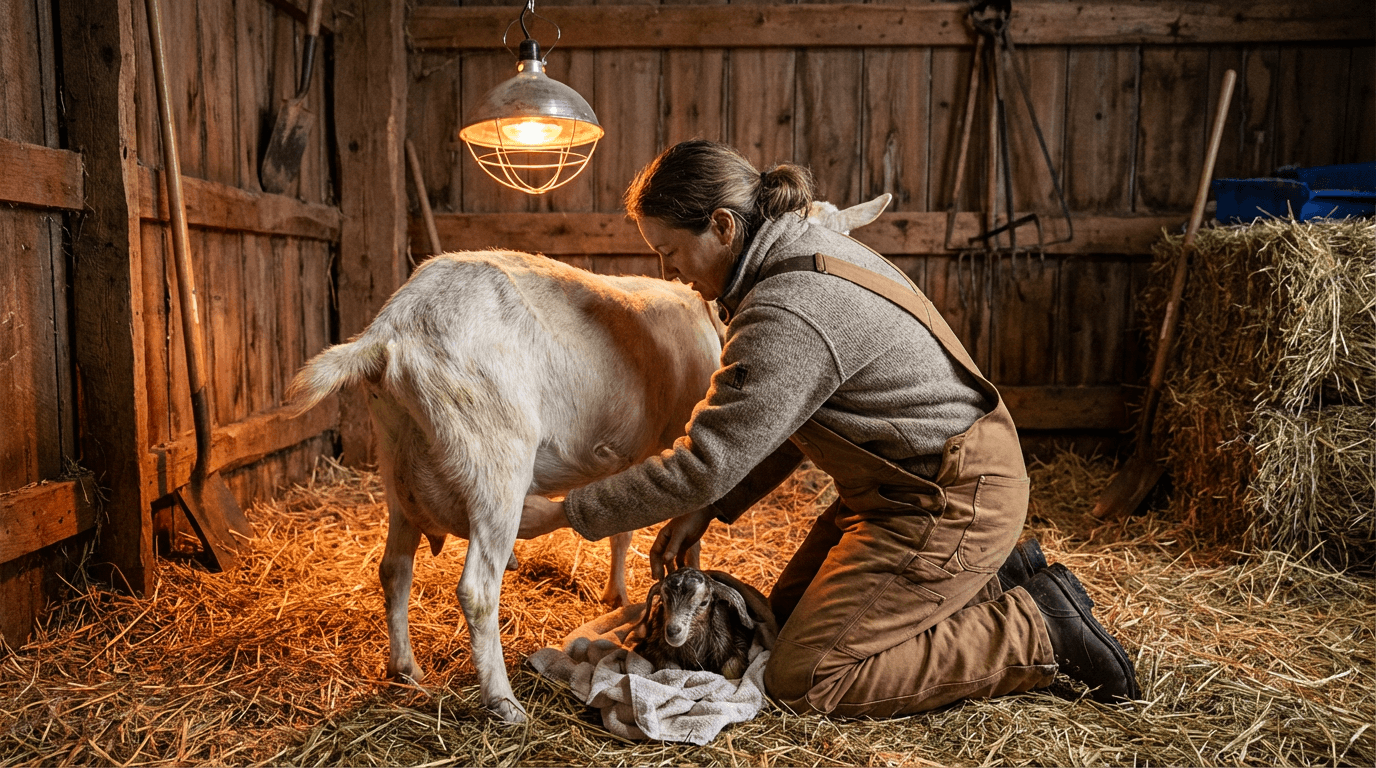
For a straightforward delivery, your role is largely observational. Have clean towels, iodine for navel dipping, a bulb syringe for clearing airways, and your vet's phone number within reach. Keep the environment clean, quiet, and draft-free. Resist the urge to interfere too quickly—does need time, and premature intervention can cause more problems than it solves.
When to Intervene: The 30-Minute Rule
The general guideline used by experienced goat producers and veterinarians: if a doe is actively pushing (visible strong abdominal contractions) for 30 minutes without delivering a kid or making visible progress, it is time to investigate. "Visible progress" means you can see feet, a head, or the kid moving down the birth canal. A doe who is mildly uncomfortable but not actively straining may still be in Stage 1 labor—give her time.
Before reaching in, scrub your hands and arms thoroughly with soap and water, then apply OB lubricant generously. Wear a long OB glove if available. Gently explore the birth canal to identify what is presented. If you cannot determine the presentation or correct a malpresentation within 5–10 minutes, call your veterinarian. Time is critical—prolonged dystocia causes swelling of the kid and the doe's tissues, making delivery progressively more difficult and increasing risk of uterine rupture.
For emergency large animal and small ruminant veterinary care, find an emergency vet near you on FarmVetGuide.
Common Malpresentations and How to Handle Them
Breech Presentation (Hind Legs or Tail First)
True breech means the tail and rump present first with hind legs folded forward. This is an emergency—the kid's umbilical cord will be compressed against the pelvis, cutting off oxygen. A backwards presentation with both hind legs extended ("posterior presentation") is manageable if delivered quickly. For true breech, you must cup each hock and extend the hind legs one at a time back into the birth canal before delivery can proceed. Call your vet unless you are experienced with this maneuver—wrong technique can rupture the uterus.
Head Back (Head Deviated Laterally or Ventrally)
Both front legs are forward but the head is turned to the side or tucked down. You'll feel the legs but no nose. Gently push the kid back slightly to create space, then use a finger to cup under the jaw and bring the head forward. A kid puller snare placed around the jaw can assist. Use ample lubrication. This is one of the most common malpresentations in goats.
One Leg Back
One front leg is forward and one is retained. The shoulder of the retained leg blocks passage. Push the kid back gently, then cup the hoof of the retained leg (to protect the uterus) and bring it forward to match the other leg. Delivery can proceed once both legs are presented correctly.
Multiple Kids Tangled
With twins or triplets, it is possible to have parts from two different kids presenting simultaneously—one front leg from kid A and one from kid B, for example. Always confirm that presented limbs belong to the same kid before applying traction. Follow a limb to its body to verify. Carefully push one kid back and deliver the other first.
Kid Pulling Techniques
Use OB chains or a kid snare (never baling twine) placed above the fetlock (the ankle joint). Pull in a downward arc—angled toward the doe's hocks, not straight back. Apply traction only during contractions, allowing the tissues to rest between pushes. Gentle, steady traction is far more effective and safer than jerking. A lamb/kid puller device provides mechanical advantage for larger kids; use with caution and ideally with veterinary guidance the first time.
Metabolic Emergencies Around Kidding
Hypocalcemia (Milk Fever) in Dairy Does
Hypocalcemia occurs when the sudden demand for calcium in colostrum production outpaces the doe's ability to mobilize calcium from bone or absorb it from the gut. It is most common in high-producing dairy does at or within 48 hours of kidding, and in does carrying triplets or quadruplets. Signs progress from early (stiffness, incoordination, muscle tremors) to late (recumbency, inability to rise, coma).
Treatment: Oral calcium gels (Calsorb, CMPK) are appropriate for early, mild cases. Does that are recumbent or unable to swallow require intravenous calcium gluconate—a job for your veterinarian or a producer trained in IV administration. Give IV calcium slowly; rapid infusion causes fatal cardiac arrhythmia. Prevention includes avoiding high-calcium pre-freshening diets (limit alfalfa in the last 3–4 weeks), providing magnesium supplementation, and monitoring high-risk does closely.
Pregnancy Toxemia (Ketosis)
Pregnancy toxemia is an energy deficiency crisis that typically strikes does carrying multiple fetuses in the last 2–4 weeks of pregnancy. The rapidly growing fetuses demand glucose that the doe cannot supply from inadequate feed intake. The doe begins mobilizing fat, producing ketones. Signs include depression, loss of appetite, muscle tremors, teeth grinding, neurological signs, and recumbency. Breath and urine may have a sweet (acetone) odor.
Treatment: Propylene glycol (60–100 mL orally, 2–3 times daily) is the standard immediate treatment. Karo syrup, molasses, or commercial drench products provide emergency glucose. Severely affected does may require IV dextrose and veterinary care. Prevention is the best approach: adequate energy intake in the last 6 weeks, especially in does carrying three or more kids. Body condition score does at breeding and midpregnancy, and adjust nutrition accordingly.
Retained Placenta
The chorioallantois (afterbirth) should be fully expelled within 4 hours of the last kid. Retention beyond 12 hours is clinically significant. Unlike cattle, goats often handle retained placentas without severe consequences if managed appropriately, but uterine infection remains a risk.
Management: Do not forcibly remove a retained placenta unless it is hanging from the vulva and creating a hygiene hazard (tie it up to prevent the doe stepping on it). Forced removal tears cotyledons, leaving tissue behind and increasing infection risk. Most placentas will be expelled within 24–72 hours. Monitor the doe closely for fever, foul-smelling discharge, depression, or decreased appetite—signs of metritis (uterine infection). Consult your veterinarian about antibiotic therapy if infection is suspected. A uterine flush performed by your vet may be appropriate in severe cases.
Cesarean Section in Goats
C-sections are occasionally necessary when the kid cannot be delivered vaginally—due to uterine inertia (the doe stops contracting), an oversized single kid, or severe malpresentation that cannot be corrected. The procedure is well tolerated in goats when performed promptly by an experienced veterinarian. Delay is the enemy: a doe in prolonged dystocia is at far higher risk than one brought to the vet early.
If you suspect your doe needs a C-section, call your vet immediately—do not wait until the doe is exhausted and in shock. Transportation stress is much less dangerous than hours of failed assisted delivery. Find a goat-experienced veterinarian through FarmVetGuide's goat vet directory.
Newborn Kid Care
Clearing the Airway and Stimulating Breathing
Immediately after delivery, clear membranes from the kid's face and nostrils. Use a bulb syringe to suction the mouth and nostrils if fluid is present. Vigorously rub the kid with a clean towel to stimulate breathing and circulation—the friction mimics the doe's licking. If the kid is not breathing, hold it upside down briefly to allow fluid to drain, then rub briskly. A straw gently inserted in the nostril (not far—just the tip) can stimulate a sneeze reflex and clear the airway.
Drying and Warming
Hypothermia is the leading killer of newborn kids, especially in cold weather, wet conditions, or if the doe is slow to clean them. Dry kids thoroughly immediately after birth. In cold conditions (<50°F), use a heat lamp positioned safely out of reach (at least 18–24 inches above the kid), a warming box with a heating pad, or warm water bath followed by thorough drying. A rectal temperature below 99°F indicates hypothermia; below 94°F is severe and life-threatening. Warm the kid before attempting to feed colostrum—a cold kid cannot absorb nutrients effectively and may aspirate.
Colostrum: The Foundation of Kid Health
Colostrum must be delivered within the first 2–4 hours of life to be maximally absorbed. The passive transfer window closes rapidly—by 24 hours, absorption is negligible. The rule of thumb: 10% of body weight in colostrum in the first 24 hours, with at least half in the first 2 hours. For a 7-lb kid, that is roughly 300 mL in the first feeding, and 300 mL more across the rest of the first day.
If the doe is unable or unwilling to nurse, use a stomach tube (esophageal feeder) for the first feeding—it is fast, reliable, and avoids aspiration risk compared to bottle feeding a weak kid. Use fresh doe colostrum whenever possible. Commercial colostrum replacers (not supplements) are acceptable if doe colostrum is unavailable.
Bottle vs. Dam Raising
Dam-raised kids require less labor, have better social development, and often have stronger immune transfer when does nurse freely. The disadvantage is less daily human handling (critical for meat breed temperament), and the risk of CAE transmission if the doe is positive.
Bottle-raised kids are necessary for CAE-prevention programs, for orphan kids, and for dairy operations where all milk is harvested. Bottle kids require 3–5 feedings per day for the first two weeks, tapering to twice daily by weeks 3–4. They become very human-bonded, which has both advantages (easy to handle) and disadvantages (nuisance behavior as adults, especially bucks). Introduce hay and water starting at 1 week; begin offering grain at 2 weeks to stimulate rumen development.
Colostrum Management and CAE Prevention
Caprine Arthritis Encephalitis (CAE) is a retrovirus transmitted primarily through colostrum and milk from infected does to kids. CAE causes progressive arthritis in adults and neurological disease in kids (encephalitis). There is no treatment or vaccine. Many commercial dairy herds maintain CAE-negative status through strict colostrum management protocols.
Heat treatment: Heating colostrum to 56°C (133°F) for 60 minutes kills CAE virus while preserving most immunoglobulin activity. Use a water bath thermometer—do not microwave (destroys immunoglobulins). Immediately feed or freeze treated colostrum. Freeze in ice cube trays for easy measured portions.
Banking colostrum: Collect excess colostrum from high-producing does and freeze for future use. Frozen colostrum maintains potency for up to 1 year. Label with date and doe identity. Thaw in warm water, never microwave.
Navel Care and Tetanus Prevention
Navel ill (omphalophlebitis) is a bacterial infection of the umbilical stump that can spread to joints and internal organs. Prevention is simple: dip the navel stump in 7% tincture of iodine (not dilute betadine) immediately after birth and repeat at 12 and 24 hours. Iodine dries and disinfects the stump rapidly.
Tetanus is a real risk in goats because Clostridium tetani spores are ubiquitous in soil. All goats should be vaccinated with CDT (Clostridium perfringens types C and D + tetanus toxoid). Does vaccinated at 4 weeks pre-kidding pass tetanus antitoxin in colostrum. If dam vaccination status is unknown, give tetanus antitoxin (not toxoid—antitoxin provides immediate passive protection) to newborns in high-risk environments.
Kid Health Problems in the First Week
Floppy Kid Syndrome
Floppy Kid Syndrome (FKS) affects kids 3–10 days old. Kids that were nursing well suddenly become weak, lose their suckle reflex, and become "floppy"—muscle weakness without other obvious disease signs. The cause is not fully understood but appears related to metabolic acidosis from milk fermentation in the abomasum. Treatment: sodium bicarbonate IV or orally (under veterinary guidance), supportive care, temporary withholding of milk followed by gradual reintroduction. Kids treated promptly recover well.
Scours (Diarrhea)
Diarrhea in kids can be caused by E. coli (first 3 days), Cryptosporidium (days 5–10), Salmonella, rotavirus, or overfeeding. Treatment centers on fluid replacement—oral electrolytes for mild cases, IV fluids for severe dehydration. Antibiotics are only appropriate for bacterial causes confirmed or strongly suspected. Maintain adequate colostrum intake and sanitation to prevent scours outbreaks.
Hypothermia
As described above, hypothermia is common and deadly. Any kid that is weak, cold, or not nursing within 2 hours of birth should be assessed and warmed immediately. Glucose via stomach tube (50 mL of 5–10% dextrose solution) can be life-saving for cold, hypoglycemic kids.
White Muscle Disease (Selenium/Vitamin E Deficiency)
Affects kids from birth to 3 months, causing muscle weakness, inability to rise, arched back, and respiratory distress (diaphragm muscle involvement). A selenium/vitamin E injection (BoSe) given to the dam pre-kidding usually prevents it. Affected kids respond dramatically to BoSe injection if given early—consult your vet for appropriate dosing. Do not overdose—selenium toxicity is fatal and the therapeutic window is narrow.
Doe Care After Kidding
Monitoring for Metritis
Uterine infection (metritis) is most likely in does that had difficult deliveries, retained placenta, or unsanitary intervention. Signs: fever (>104°F), foul-smelling vaginal discharge, depression, reduced appetite, and decreased milk production—typically 2–5 days post-kidding. Metritis requires prompt veterinary treatment with systemic antibiotics (oxytetracycline, penicillin). Untreated metritis can progress to septicemia and death.
Mastitis Prevention and Detection
Mastitis (udder infection) can occur at any stage of lactation but is most common in early lactation. Signs include a hot, swollen, painful udder half; milk that is watery, stringy, or contains clots; and systemic illness in severe cases. The California Mastitis Test (CMT) can detect subclinical mastitis before clinical signs appear. Maintain clean bedding, avoid teat trauma, practice proper milking hygiene, and monitor udder health at every milking.
Treatment depends on severity and causative organism. Mild clinical mastitis may respond to teat infusions (intramammary tubes) available from your vet. Severe cases—hardened, gangrenous udder tissue; systemic fever—require systemic antibiotics and aggressive supportive care. Chronically infected animals may become permanent reservoirs for herd transmission.
Record Keeping for Goat Herds
Accurate records are the foundation of a profitable, healthy goat herd. At minimum, record:
- Breeding dates (buck used, doe, method—natural service or AI)
- Expected kidding date (add 150 days)
- Actual kidding date and time
- Number of kids, sex, birth weight
- Ease of delivery and any interventions
- Colostrum source and amount consumed
- Vaccinations (CDT, rabies where indicated)
- Deworming treatments with product and dose
- Health events and treatments
- Weaning date and weight
Many producers use simple spreadsheets; dedicated goat management software (Goat Tracks, Little Guy's Custom Forms) automates due date calculations and reminders. Good records identify your most productive does, highlight genetic patterns in kidding problems, and provide essential information for your veterinarian.
CAE: A Comprehensive Herd Health Priority
Caprine Arthritis Encephalitis affects up to 80% of goats in some commercial dairy herds. Beyond the colostrum management strategies described above, a comprehensive CAE prevention program includes:
- Annual CAE testing (AGID or ELISA) of all animals in the herd
- Separating CAE-positive and CAE-negative animals (separate housing and milking equipment)
- Purchasing only tested-negative animals, with quarantine and retesting before introduction
- Collecting colostrum from CAE-negative does only, or heat-treating all colostrum
- Wearing gloves when assisting births or handling reproductive fluids
Building a CAE-negative herd takes years of discipline but dramatically increases the value of your animals and the health of your herd long-term.
Finding a Goat-Experienced Veterinarian
Not every large animal veterinarian is comfortable with goats. Small ruminant medicine is a specialty, and your herd will benefit enormously from a vet who works with goats regularly. When seeking a goat vet, ask:
- How many goat cases do you see per month?
- Are you familiar with FAMACHA scoring and small ruminant parasite management?
- Do you carry OB equipment scaled for goats (goats require different-sized equipment than cattle)?
- Can you perform a C-section if necessary?
- Do you have experience with dairy goat nutrition and CAE management?
Dairy goat practices often focus on production medicine, while meat goat vets may have more experience with range conditions and parasite pressure. Find goat-experienced veterinarians in your area through FarmVetGuide's goat vet directory, which lists practitioners by species specialty and service type.
Establish a veterinary relationship before you have an emergency. A vet who knows your herd, your operation, and your management approach can provide far better guidance at 2 a.m. during a difficult kidding than one hearing about your animals for the first time.
Frequently Asked Questions: Goat Kidding Problems
How long should I let a doe push before helping?
If you can see active, forceful abdominal contractions (the doe is clearly "bearing down") and no progress has been made in 30 minutes—no feet visible, no kid advancing—it is time to investigate. If the water bag has not yet appeared and the doe is mildly uncomfortable but not straining hard, she may still be in early Stage 1 labor and needs more time. When in doubt, gently check her externally: can you see anything at the vulva? Has the water sac broken? If the doe is clearly in distress, call your vet rather than guessing.
What should I do if the kid is backwards?
A posterior presentation (hind legs extended and presented first) can be delivered successfully if done quickly to avoid umbilical cord compression. Apply traction to both hind legs simultaneously, pulling downward in an arc toward the doe's hocks. Once the hips are through the pelvis, delivery is usually fast. If only the tail or rump is presented (true breech), this is a veterinary emergency—attempting correction without experience risks uterine rupture. Call your vet.
My doe has a swollen, hard half of her udder. What should I do?
This is consistent with mastitis. Strip a few streams of milk onto a dark surface and look for clots, blood, or watery milk. If the doe has a fever and the udder quarter is very hot and painful, treat it as an emergency and contact your veterinarian. Mild clinical mastitis may be treatable with intramammary tubes, but severe cases require systemic antibiotics. Do not use milk from the affected quarter for kids or human consumption until cleared by your vet.
Can I prevent pregnancy toxemia in does carrying triplets?
Yes—prevention is much more effective than treatment. Does carrying three or more kids have enormous energy demands in the final 4–6 weeks of pregnancy. Provide high-quality, energy-dense feed (grain, alfalfa hay) gradually increased from 6 weeks before kidding. Ensure adequate trough space so all does can eat simultaneously. Monitor does with a urine ketone test strip in the last 2 weeks—a positive ketone reading signals early pregnancy toxemia and warrants immediate dietary intervention. Do not allow does to become obese before breeding (BCS above 4), as fat does are paradoxically more ketosis-prone.
How do I know if my herd has a selenium deficiency problem?
The most reliable method is blood selenium testing of 6–10 animals from your herd (whole blood selenium levels). A whole blood level below 0.07 ppm (0.07 mcg/mL) indicates deficiency. Clinical signs suggesting selenium deficiency include White Muscle Disease in newborns, poor growth rates, reproductive failure (retained placentas, repeat breeders), and poor immune function. Your veterinarian can submit blood samples for selenium analysis. Know your region's soil selenium status—USDA soil maps are available online and your local extension agent can advise on regional deficiency areas.
When should I call the vet instead of trying to assist the delivery myself?
Call immediately if: you cannot determine the kid's presentation after 5 minutes of gentle exploration; you cannot correct a malpresentation; the kid or the doe appears to be in severe distress; you have been working at an assisted delivery for more than 15–20 minutes without progress; you suspect a dead or emphysematous (decomposing) fetus; the doe is exhausted, in shock, or has been in Stage 2 labor for over 2 hours with no delivery. A timely call to your vet is always better than prolonged amateur intervention. Use FarmVetGuide's emergency vet finder to locate an on-call vet near you.
Find a Vet by Species or Service